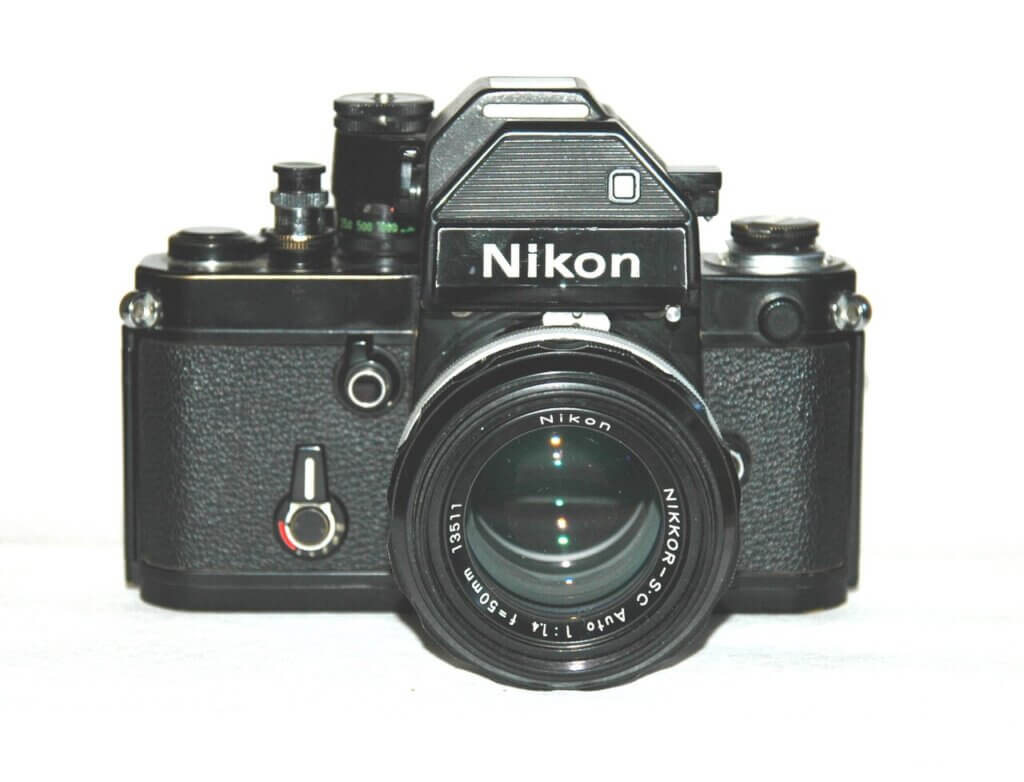
This post is a companion to the latest 3DLANES podcast episode, and derived from its transcript.
I started this research with a question: is the Nikon F2 the Speedmaster of cameras? If you clicked on the episode because of that title, here is the short answer. No. It isn’t.
The F2 was not a reaction to Canon’s F-1. It was not a NASA camera. Both of those stories are repeated often enough that they feel like facts, and neither holds up. What the F2 turned out to be is closer to the Rolex Explorer of cameras: a tough, trusted tool that earned its reputation in the hands of people who actually needed it. We’ll get to that. First, the myths.
Eight years in the making, not three
The usual line is that Nikon started the F2 in 1968. That skips the first five years of work, and I don’t want those to go unnoticed.
| Stage | Date |
| Exploratory next-generation prototypes | 1963 |
| Formal “A Camera” prototype manufacturing | September 1965 |
| Full internal redesign | Spring 1968 |
| Pre-production prototype completed | July 1970 |
| Release | September 1971 |
That is roughly six years from the formal prototype to release, and about eight if you count the 1963 experiments. “A Camera” was the program name, by the way, not a typo. Nikon already had the F in production and wanted something different, so they used the letter A instead of G, contrary to expectations. Journalists expected the “Nikon G.” Nikon went with F2 so that everyone would read it as the next step of the F, not a new line.
This timeline is also why the Canon F-1 theory fails. The F-1 reached the market in March 1971 after its own five-year program. These were two parallel developments, not a cause and a reaction.
Why Nikon replaced a camera that was selling fine
The Nikon F was a success, so why replace it? Because the problems were baked into the design. Nikon’s own history lists them:
- Handling: an awkward shutter release, a film advance lever that could hurt your finger, sharp body corners, an insecure finder attachment and an inconvenient motor drive attachment.
- Mechanics: imperfect mirror and shutter coordination, focusing effects, and limits on shutter accuracy.
- System: finder darkening with longer lenses, a smaller mirror, and a removable back and base assembly that was slower to load than a hinged door.
Nikon concluded that patching the F could not deliver the speed, durability, automation and compatibility it wanted. The mechanism had to be redrawn. The F2 shares some technology with the F, but it is close to a ground-up redesign.
The design objectives were simple to state: the highest possible quality, ease of operation and the fastest possible shooting, full compatibility, and automatic operation.
The NASA connection, and what it actually was
I’m not going to skip NASA, because there is real history here. I’m also not going to oversell it.
In 1965, NASA asked Nikon about a 220 degree lens, and Nikon delivered the Fisheye-Nikkor 6mm f/5.6. In January 1971, NASA contracted Nikon for a camera for its missions. But look at which cameras actually flew:
| Mission | Camera |
| Apollo 15 (1971) | Modified Nikon F Photomic FTN |
| Apollo 16 (1972) | Nikon F |
| Apollo 17 (1972) | Nikon F |
| Skylab (1973 to 1974) | Modified Photomic FTN |
| STS-1, Space Shuttle (April 1981) | Nikon F3 |
Notice what’s missing. NASA skipped the F2 entirely. I found no official NASA use of an F2, and Nikon’s own account says the F2 development and the NASA Nikon F project ran in parallel. A Nikon in space in 1971 does not mean the newly released F2 went to space in 1971. Let that be clear.
That is exactly where the Speedmaster comparison breaks down. The Speedmaster was selected and flown as a specific model. The F2 never was.
So did anything cross over? Two things, and Nikon documents both:
- Motor drive switching. Electronics developed for the NASA motor drive carried over into the F2 motor drive.
- The glove-inspired lever. NASA wanted an enlarged film advance lever that astronauts could work with gloves on. That broad finger pad was adopted on the F2.
That is cross-pollination during development. It is not the same as the F2 being derived from a NASA-qualified camera.
Titanium gets the same treatment. It’s tempting to assume it came out of the space program, but Nikon began titanium shutter curtain research in 1957 and had titanium curtains in production by 1959, years before the Apollo contract. The F2’s titanium mirror frame came from a different need: reducing mirror inertia and shutter lag.
What the F2 actually got right
If it wasn’t a space camera, why does it matter? Modularity, and the discipline to protect the customer’s investment.
The F2 continued the Nikon F’s system architecture rather than inventing it, and made it better. Nikon’s launch specification listed six finder types and 17 focusing screens: eye level, Photomic, waist level, high magnification and action finders, with metering housed in interchangeable Photomic heads. A hinged back replaced the F’s removable back and base, which made loading film faster. The motor drive attachment and electrical connection were redesigned around the body.
And the F lens mount carried over. If you had invested in lenses for the F, they worked on the F2. That is one of the ways a company keeps you loyal to the brand, because lenses, not bodies, are the most expensive thing a photographer buys.
How the F2 became the Explorer
In 1976, the Japanese explorer Naomi Uemura, one of the most celebrated of his era, had his cameras fail during a 12,000 kilometer Arctic dog sled traverse. He took that to Nikon. He was working at around negative 50 degrees Celsius, and he described the shock his equipment took as a repeated staircase, one jolt after another. That is how he explained it to Nikon’s engineers.
In 1977, Nikon released the F2 Titanium Uemura Special. The documented modifications:
- Titanium for the top and bottom covers, the finder (pentaprism) and the front exterior covers
- A special low temperature lubricant
- Shutter adjustment and cold testing at around negative 50 degrees Celsius
- Film transport changed to the normal winding direction, plus additional film pressure and guide measures
- Shock resistance work aimed at dog sled vibration
Nikon describes it as the world’s first titanium-exterior SLR. That is historic, for Nikon and for photography.
Only three were made, and Uemura used two of them. Two have been found. I haven’t come across anything that says what happened to the third.
A commercial version followed. Nikon ran an experimental titanium-covered F2, then marketed a limited number in 1978 with unpainted, light titanium covers. Some users objected that the reflective finish drew too much attention. So Nikon made several hundred matte black bodies, marketed as Titan in 1979, and later bodies carried a Titan engraving.
If you want one, a regular F2 usually runs somewhere around $300 to $500 online. A titanium F2 is another story, roughly $1,200 to almost $6,000 depending on condition. The Uemura cameras themselves are, realistically, off the table.
If this pushes you to buy a titanium F2, I hope you use it. These cameras were built to be used. They are tanks, not shelf pieces.
The F2 on set
One more verified user, and a good one. Chas Gerretsen, hired as the still photographer on Apocalypse Now, used two Nikon F2 bodies with motor drives on that production and kept them for later film work. So the stills you’ve seen from that film were most likely made on an F2, which is pretty cool.
A word of advice: if you haven’t seen Apocalypse Now, don’t make it a date night. I took my now wife to see it, back when we were dating. Not as a date!!! It was not a date. I had a film class, and sometimes she would sit in on the screenings. One of those days happened to be Apocalypse Now, and I had no idea what the movie was about. Google already existed. I just didn’t do the research. That one’s on me.
The verdict
The F2 is not the Speedmaster of cameras. It never flew with NASA, it wasn’t a reaction to Canon, and the titanium story is older than the space race. What it is, is an exceptionally well-engineered professional system, built to fix every complaint about its predecessor and tough enough that an explorer trusted it at negative 50.
I hope this post teaches you something about the F2, and maybe nudges you to shoot some film, or just take photos. If you have questions, comments or suggestions, leave them in the comments or reach out.
Thank you for stopping by,
DL
Discover more from 3DLANES
Subscribe to get the latest posts sent to your email.