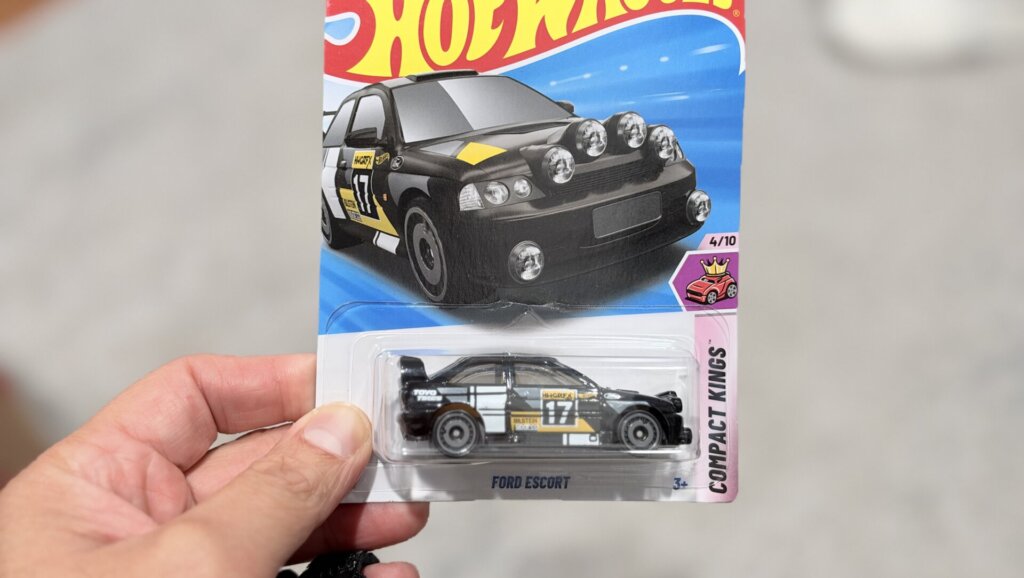
This post is a companion to the latest 3DLANES podcast episode, and derived from its transcript.
Ford has announced that it is going back to the FIA World Rally Championship. A full factory return in 2028, an all-new car in 2029, and a promise that the technology developed on the stages will also end up in the road cars Ford sells. I had this episode in the chamber for a while and had not released it. The announcement made the timing decision for me.
To judge what Ford is doing in 2028, we need to go back to the last time Ford built a rally identity from scratch. That car was the Escort.
The short version: the Escort was not created because of motorsport. It was created because Ford needed a new small car. Motorsport found it afterward, and Ford was smart enough to build a business around what it found.
The Escort Was an Anglia Replacement
Start with the boring part, because it matters most.
The Escort was not a response to a crisis. It was a proactive move by Ford management. The 105E Anglia dated from 1959, and by the mid-1960s it looked old. Its narrow two-door body and traditional package were up against fresher rivals, particularly the Vauxhall HA and HB Viva, which were closing in. Ford saw where this was heading and authorized a replacement program in 1964.
The brief was commercial, not sporting. Ford wanted to hold its position in affordable transportation, answer the Viva and the wider European compact field, and give buyers more room, performance, and finish than the Anglia offered. It also wanted a car that was cheap and straightforward to build in large numbers. The Anglia line had sold 1,829,612 cars, so this was not a replacement Ford could afford to get wrong.
Ford also did not plan one car. It planned a platform. The range included inexpensive saloons, better-trimmed Super versions, GTs, estates, and vans, with a four-door arriving in 1969. That maps onto a clear set of customers:
- Price-sensitive private buyers and company fleet users for the basic cars
- Buyers willing to pay for equipment for the Super and later luxury versions
- Families and tradespeople for the estates and vans
- Enthusiasts and competitors for the GTs
The Mk II later made this segmentation explicit. L and GL versions went mainly to private customers, Sport, Mexico, and RS2000 to performance buyers, and the Ghia to the small luxury niche that was starting to emerge.
One correction to the legend: the Escort did not dominate the market right away. It finished fourth in UK registrations in 1968, behind the BMC 1100/1300, the Cortina, and the Viva. German buyers were lukewarm, and the Escort overlapped with the Cortina and the Viva in ways that kept it from the top. Plenty of people remember the Escort as an instant best seller. The data says otherwise.
Boring on Purpose
The engineering tells you what Ford was optimizing for. Ford investigated front-wheel drive and rear-engine layouts, then settled on a conventional longitudinal engine and rear-wheel drive. That choice cut engineering and manufacturing risk. It also made the Escort less adventurous than some rivals, which was a trade Ford accepted.
The production formula was an economical unit-construction body, MacPherson strut front suspension, a live rear axle on semi-elliptic leaf springs, and rack and pinion steering, the first time Ford had used it on its smallest model. Engines were the 1098 cc and 1298 cc Kent crossflow units, with drum brakes on basic cars and front discs with servo assistance on the faster ones.
None of that is exotic. But it produced a light, simple car with direct steering that was easy to repair. Those happen to be the exact qualities a competition department wants. Production started late in 1967, and the public continental debut came at Brussels in January 1968.
The Rally Car Hiding Inside
Here is where the story gets interesting, and where three companies enter the picture: Ford, Lotus, and Cosworth. They worked very closely together at the time, which is why the other two will keep showing up in what is technically a Ford story. If you listened to the Cosworth episode, you already know the relationship.
Three people matter here.
Henry Taylor was the competition manager at Boreham, Ford’s competition department in England. He looked at the new Escort shell and saw a smaller, stiffer successor to the Lotus Cortina. He expected Alpine, Porsche, and Lancia to make the heavier Cortina obsolete, and he proposed installing the Lotus Cortina powertrain, the Twin Cam, in the Escort.
Walter Hayes was the public affairs director, responsible for motorsport. He backed Taylor and obtained corporate support, which meant overcoming internal resistance to a low-volume special inside a company built around volume.
Bill Meade was the technical leader at Boreham. In 1967 he and his mechanics proved the twin cam installation over a weekend, using a plastic body replica of the Escort.
Read that sequence carefully. The Escort was already on its way, to replace the Anglia. Motorsport did not trigger it. Motorsport arrived in parallel. The Lotus Cortina was leaving a void, and Boreham saw the opportunity and took it.
Competition also changed the car. The first international rally exposed weak rear damper geometry, which led Ford to more upright, turreted damper mountings. The requirements of homologation, which means producing road cars so the competition version is legal, pushed changes into suspension, shells, engines, and serviceability. That is a large part of what turned the Escort into the icon it is now.
Why Ford Chose Its Races Carefully
Hayes had been recruited when Ford management wanted a new image to go with newer products. The pre-1960s Ford was profitable, but it had no sporting image. It was good at selling cars and short on racing heritage, which is exactly what Hayes was brought in to fix.
The clearest window into how Ford thought about this is a 1975 interview with Stuart Turner. It describes a managerial theory of return, and it is surprisingly disciplined:
- Choose events that matter commercially
- Aim for a result simple enough to communicate, which usually means an outright win
- Activate it through advertising and dealers
- Avoid spending on success the public would regard as minor
In other words, Ford went after high-profile, World Cup-style events and skipped the small wins.
The London to Mexico World Cup Rally in 1970 is the best example. Here is the part I flagged in the episode as curious. Ford did not bring its most exotic engine. It chose a robust, easily serviced pushrod engine, and for a 16,000-mile event, reliability and serviceability mattered more than maximum output. The result was Escorts finishing first, third, fifth, sixth, and eighth, five of the first eight places.
Then came the commercial move. Within months, Ford used the winning destination as the name and advertising foundation for a road car. That was the Mexico. It is how Ford turned an expensive competition program into something people could actually buy.
The same logic produced the RS2000. Both cars sat below the expensive, exotic RS1600, and both were simpler and easier to own. The Mexico reportedly outsold the RS1600 by nearly ten to one, with a commonly quoted production total of 10,352.
One caution, because I would rather be straight with you than tidy. I was not able to confirm how many ordinary Escort sales were caused by motorsport, as opposed to price, fleet demand, body variety, and Ford’s general marketing strength. Ford’s own documentation describes RS as important to its sporting image. Nobody has published a clean number that says how important. The Mexico total itself should be treated carefully too, since some knowledgeable sources think the real figure may be lower.
The Formula, and How It Faded
By the early 1970s, Ford saw that the formula worked and went all in. The RS1600, arriving in 1970 with a Cosworth engine, cemented it:
- A homologated road car
- A Cosworth engine
- Works development
- Factory competition parts
- Specialist dealers
- A distinct RS identity
By the end of 1970, one historical account counts 66 Rallye Sport dealers in the UK. This was not a racing team with a road car attached. It was a product system.
The Mk II, nicknamed Brenda, was the peak. It was a joint British and German reskin and refinement of the Mk I structure, not a clean-sheet car. It kept rear-wheel drive and the competition base, and it won the RAC Rally every year from 1975 through 1979. In 1979, Ford won its first World Rally Championship manufacturers’ title, and Björn Waldegård became the first official drivers’ champion. Ford then withdrew its works team at the moment of success, which looks counterintuitive until you see what it was preparing next.
What it was preparing was the Mk III, nicknamed Erika, an efficient front-drive hatchback built to compete with the Golf and the Civic, with new CVH engines and independent suspension. This is where the whole thing starts to wobble. Winning rallies was not the primary focus of this car, and the public could tell. Road performance and rallying had separated.
By 1990, the CE14 Escort launched with carryover engines and heavy criticism of its steering, dynamics, seats, and interior. The RS Cosworth that followed wore Escort bodywork over a shortened Sierra platform. That is a huge disconnect from where the story began, when the competition car and the road car shared a shell. Cost and marketing assumptions had overpowered the product attributes that supported the earlier Escorts, and the Escort name could not carry a weak mainstream car.
That is the lesson I take from the Escort’s arc. Motorsport credibility is an asset, but it only pays off if the car in the showroom earns it.
The Escort at a Glance
| Model | Introduced | Purpose |
| 1100 / 1300 | 1967-68 | Mass-market Anglia replacement for private buyers, fleets, and families |
| 1300 GT | 1968 | Attainable showroom performance below the Twin Cam |
| Twin Cam | 1967-68 | Homologation special and successor to the Lotus Cortina; first 25 largely hand-built |
| RS1600 | 1970 | Cosworth BDA engine; Ford’s homologation and works development base |
| Mexico | 1970 | Road version of the London to Mexico winner; simpler 1.6 Kent engine |
| RS2000 Mk I | 1973 | Near-RS1600 performance with a 2.0 Pinto engine; lower cost and easier to own |
| RS1800 Mk II | 1975 | Very low-volume road base for the Group 4 works rally cars |
| RS2000 Mk II | 1975-76 | High-volume, road-oriented halo model with the “droop-snoot” nose |
| XR3 | 1980 | Front-drive hot hatch aimed at the Golf GTI; styling and price did the selling |
| RS Turbo | 1984-85 | Group A homologation special, turbocharged 1.6 CVH |
| RS Cosworth | 1992 | Group A homologation car on a shortened Sierra four-wheel-drive platform |
Escort Timeline
| Date | What happened |
| 1959 | The 105E Anglia launches |
| 1964 | Ford authorizes the Anglia replacement program |
| Early 1967 | Henry Taylor, Walter Hayes, and Bill Meade prove the Twin Cam concept |
| Late 1967 | Halewood production starts |
| January 1968 | Public debut at Brussels |
| February 1968 | Prototype Twin Cams win rallycross at Croft, on television |
| 1968 | Escorts win the Circuit of Ireland and the 1000 Lakes |
| January 1970 | RS1600 production begins with the Cosworth BDA |
| April-May 1970 | London to Mexico World Cup Rally: five Escorts in the top eight |
| November 1970 | Mexico launched; Ford’s specialist operation at Aveley opens |
| 1973 | First World Rally Championship season; RS2000 launched |
| June 1974 | Two-millionth Escort announced |
| 1975 | Mk II “Brenda” and RS1800 arrive |
| 1975-1979 | Five consecutive RAC Rally wins |
| 1979 | Ford wins its first WRC manufacturers’ title; Waldegård is first drivers’ champion |
| September 1980 | Mk III “Erika”: front drive, hatchback, XR3 |
| 1990 | CE14 Escort launches to heavy criticism |
| 1992 | RS Cosworth enters production |
| July 2000 | British Escort passenger-car production ends |
What This Means for 2028
Now to the present. Ford says the 2028 return will help shape five new European multi-energy electric and hybrid passenger vehicles. It describes the WRC as both a proving ground and a way to give those vehicles a responsive, confidence-inspiring, engaging driving character for Europe’s variable roads. This is aimed squarely at Europe, where rallying is huge.
Ford is also not new to racing. It has a joint venture with Red Bull, where it provides engines. Its WRC return would be one part of a wider motorsport portfolio.
Ford Europe president Jim Baumbick has been specific about what “rally-bred” is supposed to mean. It is not styling and it is not a badge. It is responsiveness, composure, control, and engagement. He also frames the program as a competitive differentiator against commoditized, appliance-like vehicles. My own translation: Ford does not want to build another Tesla-type car, a great car that gets you from A to B and is very fast in a straight line, but is not a driver’s car.
The direction of influence is also different. The announced program is bidirectional. The road-car portfolio will help define the rally car, with the 2029 car inspired by one of the upcoming passenger vehicles, while WRC engineering and testing are expected to influence the road cars. As I said at the top, a lot of the technology developed in the WRC is expected to flow into road cars.
Similarities and Limits
There are real similarities. Both programs use rallying to give Ford a distinct character, both lean on specialist partners, and both treat competition as public proof, not just private testing.
But the motivations are not identical, and this is the part I find most interesting.
The first Escort was an opportunity. It was close to heaven-sent: the right time and the right place, a mass-market shell dropped into a 1960s campaign to build Ford’s image. Ford did not plan for it so much as recognize it. The 2028 return is the opposite. Ford is announcing it in advance, as part of an integrated product-development and brand-differentiation program that involves electric and hybrid cars, customer experience, a global motorsport portfolio, and new championship economics.
We have seen this logic work for other brands. Porsche has used motorsport for decades. Audi is going back into Formula 1, and Cadillac is entering as well. Motorsport is not just for fun. It helps brands develop new technology. Honestly, why some brands stay out of it is a question I cannot answer, and that might be a good topic for a different episode.
Here is where I leave it. The original Escort story is a lesson in recognizing an opportunity and building a business around it. The 2028 story is a test of whether a company can plan that kind of credibility on purpose. The Escort’s own decline offers a warning for Ford: heritage only works while the car in the showroom is worth owning.
That is the brief history of the Ford Escort.
Thank you for stopping by,
DL
Discover more from 3DLANES
Subscribe to get the latest posts sent to your email.