This post is a companion to the latest 3DLANES podcast episode, and derived from its transcript.
Last episode was Volkswagen. This one is Zodiac. Different industries, different scale of disaster, but the same underlying exercise: pull apart the timeline, listen to what leadership actually said versus what the analysts and the enthusiast community said after the fact, then check the competitors to see if the excuses hold up. With Volkswagen it was engineering fraud and corporate culture. With Zodiac, nobody broke the law. What they did was make a series of management decisions that, one at a time, looked defensible, and that in sequence built a brand that’s now sitting on the discount rack at Ross next to whatever else didn’t sell.
A quick history
Zodiac was founded in Switzerland in 1882 by Ariste Calame and ran as a family business for over a hundred years before ownership started changing hands. The brand’s real claim to fame came in 1953 with the Sea Wolf, one of the first commercially available dive watches, launched around the same time as the Blancpain Fifty Fathoms and the Rolex Submariner. Unlike those two, the Sea Wolf was pitched as a functional, accessible tool watch, not a prestige piece. That positioning is worth remembering, because it’s the opposite of where the brand ended up decades later.
Then came the quartz crisis. Zodiac, like most Swiss mechanical brands, got flattened and spent the better part of two decades in commercial obscurity. Fossil Group bought the brand in 2001, along with the associated Swiss manufacturing entities: Montres Antima SA and Swiss Technology Production, or STP, a name that matters later too. Zodiac was now a heritage Swiss name living inside an American fashion accessories company.
The revival, and the mistake
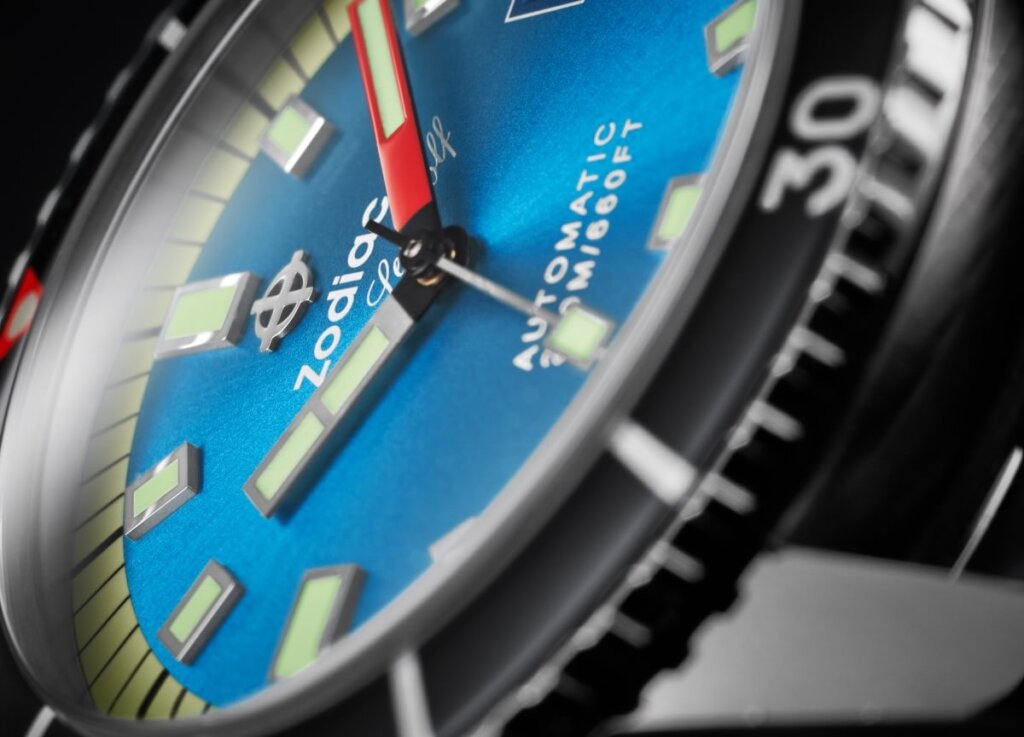
The modern comeback starts in earnest in 2015, when Zodiac reissued the Super Sea Wolf as a limited edition leaning hard on the 1970s design language: 44mm cushion case, crown and stem update, STP 1-11 movement. From 2015 to 2018, the brand followed that up with a wave of limited edition collaborations: Liberty of London, HODINKEE, Worn & Wound, and a rotating cast of colorways.
It worked, in the sense that people paid attention. It also didn’t work, in the sense that matters. Mike Pearson, well known in the watch industry and someone who was at Zodiac during this stretch, has said plainly that the problem with the collaboration run was that there was nothing to fall back on. There was no core catalog. Every drop was a flash of relevance and then nothing. You can get people to notice a brand that way. You can’t get them to buy into it.
I’d add something Mike Pearson didn’t say but the outside commentary did: it wasn’t just a strategy gap. Watch enthusiasts and collectors who bought into those early Fossil-era releases have been pretty consistent that the QC was questionable and the whole thing read as a little inauthentic, a heritage name being used to move product rather than a heritage name being rebuilt. Those are two different failure modes stacked on top of each other, and it’s worth separating them, because Zodiac’s own internal narrative only really owns the first one.
Even Zodiac’s published brand history on its own website quietly stops updating in 2018. Pearson later described that stretch as a period “still being written.” That’s a generous way of putting it.
The course correction
To Zodiac’s credit, 2021 onward is a real pivot. The brand starts consolidating around a defined core collection instead of a rotating cast of limited runs, and standardizes on in-house STP movements across the lineup. Between 2021 and 2023 the Super Sea Wolf family expands into a proper range (ProDiver, GMT, Skeleton, compression models) priced generally between $1,095 and $2,495. This is the internal capability building story: vertical integration, discipline, a real catalog you can point to instead of a memory of a drop that sold out eighteen months ago.
Then in 2023, Zodiac launches the Sea-Chron chronograph on a Sellita SW500, not in-house. Every other model up to that point had been running the in-house STP movement. It’s a small thing on paper and a real signal underneath it: the discipline that was supposed to be the new foundation had an exception in it almost immediately.
By 2024, Zodiac is doing limited-edition collaborations with eBay, framed by then-creative director Ryan White as striking a balance between honoring the archive and reaching new collector audiences. Fine as far as it goes. But it’s worth noticing the shape of the pattern: the brand that supposedly learned its lesson about collaboration-driven hype in 2018 is back doing collaboration-driven hype in 2024, just on a different platform.
Two stories
Here’s where it gets useful. Zodiac and Fossil’s own materials frame the 2021 to 2024 period as internal capability building: in-house movements, a disciplined core collection, brand-led creative direction. That’s the story told from inside the building.
The story told from outside the building, in a 2026 retrospective, is about positioning and pricing. Pushing into the $2,000 range put Zodiac in direct competition with Longines, Oris, and sharper independents like Christopher Ward, who at the time had offerings for less. Having in-house movements and a real catalog might have been the “winning ticket” internally. Externally, it was just a ticket. It got Zodiac into a room full of brands with more history, more stability, and in some cases better prices, without giving Zodiac a clear reason to be chosen over them once it was in that room.
Both explanations are probably true at once. Internal discipline without external differentiation doesn’t move you up a category. It just moves you into a more crowded one.
Fossil
None of the brand-level strategy matters much once the parent company falls apart. Fossil Group filed for bankruptcy and restructured in 2025. By early 2026, Zodiac watches are sitting on the brand’s own website at roughly half of retail, and the Super Sea Wolf line is showing up at Ross, the discount clothing chain, for a fraction of MSRP. This is well documented by the enthusiast community at this point. A lot of people picked up watches that way, and good for them, but it’s not the outcome you want if you’re the brand.
The collector community read on this is important: the discount bin situation isn’t necessarily Zodiac’s fault as a brand. It’s Fossil’s fault as a parent company. Zodiac doesn’t get to operate independently of the financial health of the group that owns it, no matter how good the internal strategy looks on a slide.
against Longines and Oris
Longines and Oris compete with Zodiac on heritage and price point, but they’ve had more historical continuity and more stable identities. Between 2015 and roughly 2021, the entire watch industry, not just Zodiac, was running some version of the limited-edition, quick-buck playbook. Zodiac may have been early to it, but it wasn’t alone. The difference is that Longines and Oris didn’t lean on the rotating catalog and monthly novelty drops the way Zodiac did, and they didn’t get the same critique for it. Longines belongs to a group too, the Swatch Group, and hasn’t gone out of business or ended up in a discount bin. Stability at the parent level matters as much as strategy at the brand level, maybe more.
Where that leaves it
Zodiac’s core problem was never a single bad call. It was a sequence: build hype without a foundation, build a foundation without differentiation, then get undercut by a parent company’s balance sheet before any of it had time to compound. Each individual decision (the collabs, the in-house movement push, the price increases, even the Sellita exception) has a defensible logic on its own. Stacked together, they add up to a brand that did a lot of the right internal things a few years too late, in a market that had already moved on, owned by a company that couldn’t hold up its end regardless.
Thank you for stopping by,
DL
Discover more from 3DLANES
Subscribe to get the latest posts sent to your email.