This post is a companion to the latest 3DLANES podcast episode, and derived from its transcript.
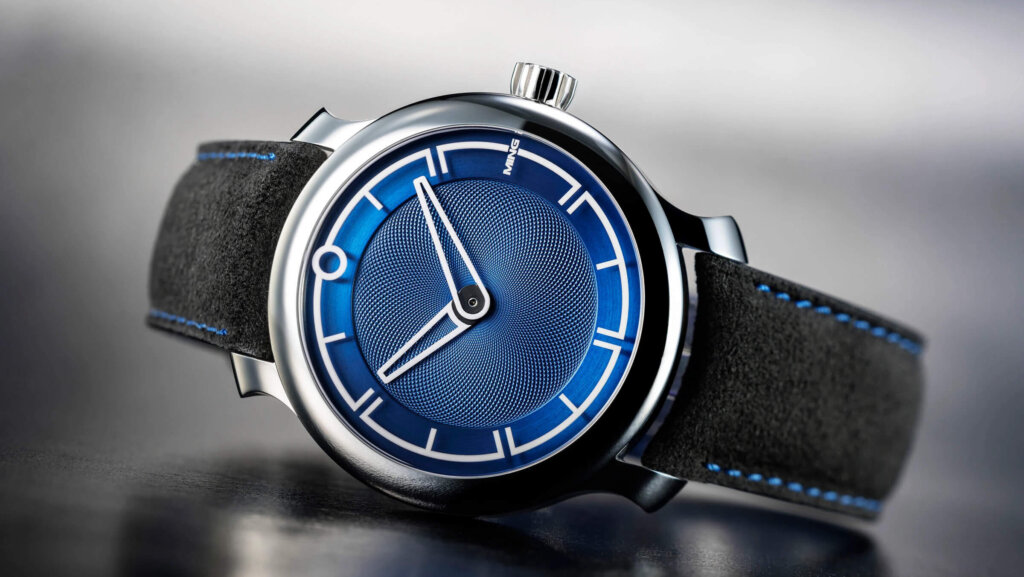
This topic has been in my head for a while, ever since I discovered the MING 17.09. The 17.09 does something most watches do not: its hour hand can be moved on its own, in one-hour jumps, while the minutes and seconds keep running. I don’t want to call it a complication, because it adds nothing to the dial. It is not a chronograph, a GMT or a perpetual calendar. It is a function, and a very quiet one.
What it actually is
Terminology first, because it matters here. The function has four characteristics:
- One conventional 12-hour hand shows local time, just like a regular three-hander.
- That hand can be corrected without moving the minute hand.
- The correction does not stop or reset the underlying timekeeping.
- Preferably, it works in both directions, one hour at a time.
Omega calls it the “time zone function” and describes it as letting you adjust the hour hand to different time zones without stopping the watch. Collectors use other names: independent hour hand, quick-set hour, traveler-hour correction. I’m avoiding “jumping hour,” because that term also describes watches whose hour display jumps on its own at the top of every hour. Different animal.
It is also not a GMT. A GMT keeps your home time alive on a second hand. This function has no memory of where you came from. It simply moves local time to where you are.
The question that started it
Not long ago I traveled with the family for a few days, in a different time zone. I didn’t care what time it was back home, so a GMT was not what I needed. I could have worn one, but I didn’t need to track two time zones. I needed one: the one I was standing in.
That is when the question hit me. Why isn’t this on every watch?
Yes, there’s a caveat. Nobody needs a watch anymore. They are a luxury and a convenience. You can buy an Apple Watch for less than many wristwatches, and a G-Shock for less than that. But within the world of watches that do exist, this still seemed like a gap.
So I asked someone who would know. Rob Nudds, the friendly neighborhood watchmaker from the TRTS podcast, gave me a simple answer: you’re adding complexity to something nobody really needs. More assembly time, more parts, more points of failure. It could be done, but if there’s no demand, why bother?
His answer was so plain that I almost scrapped the episode. Then I asked a different question. Forget why it’s rare. Does anyone actually make one?
Who has it today
The MING 17.09 was the only one I knew about. It turns out the function is far more widely available than I assumed, and it isn’t limited to boutique watchmakers. Here is what I found, ordered roughly by price.
| Brand | What I found | Approximate price |
| MING | 17.09, a modified Sellita SW330 | Around $3,000 today |
| Grand Seiko | Two quartz models | Around $3,000 new |
| Citizen | 27 models on Citizen’s site at the time of recording, with the A060 movement | Around $3,000, at the top of Citizen’s range |
| Omega | 134 watches in the current lineup | Roughly two to three times the Citizen and Grand Seiko price |
| Panerai | Luminor Marina Carbotech PAM 01707, with the P.9010 movement | Around $15,000 |
If you’re against quartz, the Grand Seiko and Citizen options won’t be for you. For everyone else, they are the cheapest way in.
Panerai deserves a note. The PAM 01707 is the only watch in the current lineup that I could find with the function. Panerai’s P.9010 movement carries it, but I would not assume it applies to every Panerai automatic.
Omega is the real surprise. I expected a handful at most. Maybe the Aqua Terra, one out of every ten or so. Instead, it is nearly everything: Planet Ocean, Constellation, De Ville Prestige, Aqua Terra, Seamaster, the Speedmaster family including the Dark Side of the Moon and the Chronoscope, and even the Ploprof. A hundred and thirty-four watches. Function should still be confirmed calibre by calibre, since Omega’s compact 8800 family, for example, assigns that crown position to the date instead. But the scale is remarkable.
There is also a difference in how they get there. The MING is a modified Sellita SW330, a regular GMT movement reworked to do something it was not designed to do. Omega’s mechanical movements, by contrast, were built with the function from the start. The 8500 family was designed with automatic winding, a date and the time zone function together, not as an add-on to a finished movement.
My read on Omega is this. It belongs to the Swatch Group, and it has scale. When you put the same function in 134 watches, the engineering investment pays for itself, whether or not the buyer ever notices. That is my inference, not a number Omega has published.
It didn’t start with Omega
I didn’t want to stop at recommending a brand. I wanted to know where this came from, and the answer surprised me too. Omega is the company that uses it most widely today. It was not the originator.
| Year | Watch or movement | What it did |
| 1958-59 | Patek Philippe ref. 2597 (Louis Cottier’s mechanism) | Case pushers advanced or rewound the conventional hour hand in one-hour steps. The first series needed no second 24-hour hand. Later versions added dual-time. |
| 1969-70 | Bulova Accutron Astronaut Mark II | A second crown moved the primary hour in exact one-hour steps. It also carried a second-zone indication, so it is not a pure single-time display. |
| 1973-74 | Omega Megaquartz 1510 | Earliest commercially documented Omega example, and an early quartz implementation. |
| 1995 | Grand Seiko 8J55 and 8J56 | High-accuracy quartz three-hand date movements with independent hour correction. |
| 1995 | Citizen A660, later A060 | The same idea, again in high-accuracy quartz. |
| 2003 | ETA patent EP1544691 | A filing, not a product. A mechanical solution for correcting the hour in both directions. |
| 2007 | Omega 8500 / 8501 | First modern Omega three-hand mechanical family with the function. |
| Mid-2010s | Panerai P.9010 | The conventional hour hand can be changed independently for time zone correction. |
| 2020 | Grand Seiko 9F85 | Three-hand date, no GMT hand, derived from the 9F86 GMT of 2018. Grand Seiko calls it the “time difference adjustment function.” |
| 2021 | MING 17.09 | Modified Sellita SW330-2. Hour hand advances independently, forward only. |
Look at that list and a pattern emerges. Most of these are not new. The idea is nearly seventy years old.
Why Omega did it. On the Megaquartz, I could not confirm Omega’s reasoning, and neither could the research I found. What can be inferred from the technical documentation is that moving only the hour hand let the extremely accurate oscillator and the seconds indication keep running undisturbed during a time zone change. In a watch sold on its accuracy, stopping the movement would have defeated the point. But I have never found Omega saying that in so many words.
The ETA connection. In 2003, ETA filed the patent listed above. ETA belongs to the Swatch Group, as does Omega, and the patent’s function and timeline closely match the Omega 8500 that arrived in 2007. The patent does not name the 8500, and I haven’t found anyone at ETA or Omega connecting the two directly. But the link is hard to ignore.
What Omega has said openly is what the function is for:
- Crossing time zones.
- Preserving uninterrupted timekeeping.
- Correcting for daylight saving or seasonal time changes.
- Keeping the date synchronized with local time as the hour hand crosses midnight.
So why isn’t it everywhere?
Rob’s explanation holds up, and the research adds detail. Here are the documented obstacles.
- The calendar. ETA and Grand Seiko have both documented how hard it is to combine hour indexing with a fast-switching, instantaneous calendar. ETA’s patent notes that such a calendar can create resistance several times greater than the hour-correction coupling can safely handle. In plain terms, the date wheel doesn’t play nice with this function.
- More mechanism. You need a second path to drive the hour, a detent to index it, and extra levers to select the crown mode. More stuff.
- Crown position competition. The extra crown position that handles the hour displaces the usual quick-set date. On most of these watches, you fix the date by moving the hour hand past midnight. That is convenient for a day or two, and tedious if the watch has been sitting for weeks. Some watches with this function simply don’t have a date.
- Modification risk. More on this below.
- A simpler alternative. A GMT built on the Sellita SW330 gives you a second time zone without redesigning how the hour and date work together. Plenty of watches use that movement, including the Oak & Oscar Humboldt GMT.
The MING lesson
MING is a good case study, because it shows what happens when you retrofit this function onto an existing movement. To be clear, I have had no communication with MING. This comes from what they have published.
Before deliveries, MING reported problems with the hour-gear spring, the cam profile and the jumper-spring profile. The result was inconsistent independent hour operation. They delayed shipments, upgraded the components and extended the warranty from two years to three.
That does not prove the mechanism is unreliable in general. It does show that spring strength, cam geometry and quality control become real problems when you bolt a function like this onto something that wasn’t built for it. I’m a little sad the 17.09 hasn’t come back. MING is always trying to do cool stuff, and for them to attempt this tells me there is something here.
A niche within a niche
Here is the honest limit of the evidence. Nobody has published figures on what this function adds to cost or assembly time, or on how many buyers actually want it. Rob’s reasoning is plausible, and it nearly talked me out of this episode, but it is inference, not data.
What I can say is this. A useful function with nearly seventy years of history, real engineering behind it and significant adoption by a company like Omega remains so obscure that many buyers have never heard of it. I bet plenty of Aqua Terra owners don’t know it is on their wrist.
Besides the date, I think this might be the most useful function a watch can have, especially if you travel. Think of anyone on the road for work: sales, or technical roles where you go to a different place to help out or fix something. It is underrated, and I’m here to promote it. We need more of this.
If you own one of these watches, tell me whether you actually use it.
Thank you for stopping by,
DL
Discover more from 3DLANES
Subscribe to get the latest posts sent to your email.