This post is a companion to the latest 3DLANES podcast episode, and derived from its transcript.
Volkswagen again. Sorry, not sorry.
I’ll start with the bias, because it’s only fair. I grew up in a third world country, and my dentist had a friend on my street. After clinic hours he would stop by to visit, and he always showed up in the same car: a lowered Mk4 Golf in Tornado Red. It was clean. That was the car I wanted. These days I own a Mk7 GTI, I’ve had it for a long time, and there is no version of the future where I get rid of it. (Before it, I had a ’96 Miata. I regret selling it, but that’s a story for another time.)
That history is why I care about where the brand is going. Volkswagen has fans all over the world, and it is tough to watch the path the company has taken and the mistakes it has made. I covered how they ended up in this spot back in episode 84 of the podcast. The layoffs and the hardship make the headlines, but none of this is new. The sketchy decisions go back to Dieselgate.
How we got here
The timeline is easy to lay out.
Dieselgate. This is where it started. Volkswagen got caught in the U.S. over emissions and was penalized for it. The shortcuts were the problem: the company could not technically back up what it was promising, and the diesels were polluting well beyond those promises.
The ID era. Next came an aggressive push into electrification. The ID line was positioned almost as a new sub-brand, a new identity for Volkswagen. The cars were expensive and technologically differentiated, but design-wise they all looked alike. I could not see a meaningful difference between them. It was messy.
Software troubles. There were software problems on top of that. I’m not going to rehash them here.
The return of the old names. Now the strategy is shifting. The electric cars are getting heritage names. The GTI is the new electric car that was just announced, and the Polo has been around for a little while. The Polo and the GTI might not make it to the U.S., but the bus is supposedly coming back here. I gave my thoughts on that one in episode 55.
Running underneath all of this is MEB, the Modular Electric drive toolkit. The acronym is German (Modularer E-Antriebs-Baukasten or Modular Electric Drive Matrix), but the idea is simple: think of it as Legos for electric cars. Every EV is built from largely the same modules on a specific platform, which gives Volkswagen economies of scale and saves on the cost of building cars.
The question
Here is my thesis, framed as a question. Could Volkswagen be making Volkswagens again?
The people’s car has been saved before. The Beetle did it. The Golf did it. The van did it. Is the next one coming out of the current mess? It could be, but we can’t count the chickens before they hatch.
What we do know is that Volkswagen is sticking with electrification. That part is obvious. They are expanding their EV lineup even though some of those cars will not come to the U.S. They are not backing up. What is changing is how they execute. My framing: VW may have been right about electrification, and wrong about what a Volkswagen is.
The engineering side: Mission Efficiency
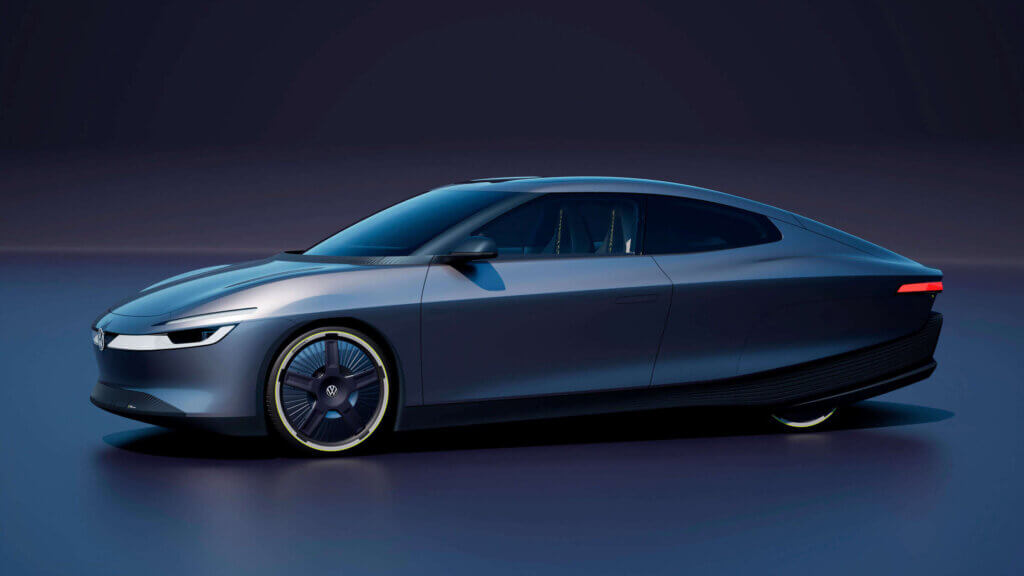
The car that could be the trigger is the Mission Efficiency. A caveat first: it is a prototype, not a production car. Some people expected it to be one, but it isn’t. It’s Volkswagen playing with new technology to see what is possible.
Everybody made fun of the shape, and fair enough. People were comparing it to a Honda Insight. It’s not the best looking car. But the substance is where it gets interesting. Strip it down and the Mission Efficiency is basically a Polo. They changed a few dimensions, so it’s longer, and the shape is obviously different, but a lot of the components come from the Polo. Then they made it about 30% more efficient.
That number matters because of how they got it. The easy move is to add a bigger battery, which adds weight and cost. Instead, they went after consumption. Less energy used means a smaller battery requirement, less weight, less material, and potentially a lower cost. That last part is yet to be seen. Again, this is a prototype.
A few things stood out to me.
| Area | What they did | Why it matters |
| Brakes | A semi-dry system. The front brakes are the hydraulic Polo brakes (it’s a front wheel drive car). The rear brakes are electromechanical, with no brake lines and no brake fluid. | Friction on the rear axle drops to almost zero. Less weight, fewer components, better packaging, and improved regenerative braking, so more energy goes back to the battery. |
| Infotainment | Bring your own device. There is no infotainment system. Your phone plugs into a rail and becomes the system. A smaller screen handles the AC and vents. | Less computing hardware, no large display, less wiring, fewer electrical components. You already carry a huge piece of technology in your pocket, so why not use it? |
| Sound | No speakers. A portable Bluetooth speaker does the job. | It works, but people who care about sound quality may not buy in. Maybe they bring their own speaker. I’m curious to see how this plays out. |
| Solar | A photovoltaic system built into the glass roof. | It covers some of the auxiliary energy demand, not traction, but it adds range to the battery: about 30 kilometers a day. Season, weather and location all matter, so it isn’t guaranteed. A small change with a big gain. |
| Aerodynamics | Wheels alone account for 25 to 30% of the car’s aerodynamic resistance. | Efficiency is the whole game here, and the wheels are a big piece of it. |
| Weight | Lightweight panels, simplified door construction, no ambient lighting, lightweight flooring with no floor mats, and some components in recyclable 3D printed materials. | Every one of these removes complexity, and complexity is weight. |
The interior is very minimal, but I don’t want to confuse that with Scandinavian design. This isn’t about looks. It’s about weight savings, and simplicity to get there. If you can see the photos, do yourself a favor and look them up. They are very interesting.
The brakes are a good example of what I like about this car. They didn’t improve on the convention, they questioned it, and they came back with something different. That is innovation, and it is what Volkswagen needs.
“Democratization”
If you listen to the show, you know the word “democratization” bothers me. It’s what Volkswagen called this movement in the press release: the democratization of e-mobility. Fine. Strip the label off and the strategy is very close to what Volkswagen has done before.
- Focus on engineering.
- Make everything standard, which is what MEB and its scale are for.
- Useful transportation.
- An attainable price.
That last one is where the ID bus failed. It was not an attainable price. Hopefully, when they bring it back and change where it is built, they realize the mistake and price it so people can actually buy it. But that’s a topic for another time.
The MEB toolkit is how Volkswagen can reach this goal, and if the ideas from the Mission Efficiency migrate to the mass market vehicles, that is going to be huge.
The emotional side: GTI and Polo
If the Mission Efficiency shows the engineering Volkswagen is pursuing and how it is trying to be different, the GTI and the Polo are the emotion. They are Volkswagen trying to keep its heritage alive, using the old names on the electric propulsion technology the company is advocating for. This isn’t the Mission Efficiency technology specifically. It’s the broader electric platform.
Volkswagen says the Polo name carries reliability, personality and history, and the GTI is being brought into the electric world. Note that it is the ID.3 GTI, not the Golf GTI. And as far as I can tell, it’s the very first rear wheel drive GTI ever. That is a big deal on its own.
I think it will be a turning point for Volkswagen. Whether people adopt it in volume is another story. Hopefully it’s a good car. I’m not saying I’d buy one, because that wouldn’t be true. I want to see the car first and judge whether it’s true to Volkswagen. I don’t even have the funds for a new car, but whatever.
Where I land
Put it all together. Volkswagen did the electrification and is sticking with it. The ID branding didn’t work, so the old, trusted names are coming back, now with electric propulsion. The Mission Efficiency shows them trying to simplify, cut weight and attack cost, even if it isn’t a production car.
From where I sit, Volkswagen might be going in the right direction. Yes, they can build EVs. I know some people like the IDs, and that’s okay. But the question I want to leave you with is this: is Volkswagen remembering how to build a Volkswagen?
Where do you stand? Is Volkswagen on the right track? Is it done? Did it never lose it? I think they might be coming back, and I hope they are. I’m a brand believer. I really like Volkswagen, and I would hate to see them go. We’ll see where they land.
Thank you for stopping by,
DL
Discover more from 3DLANES
Subscribe to get the latest posts sent to your email.