This post is a companion to the latest 3DLANES podcast episode, and derived from its transcript.
If you’ve followed the path I’ve taken through photography, cars, and watches, you probably already know I shoot a fair amount of film. Instagram gives it away. And yes, I’m aware it’s a strange hobby to double down on right now. Nobody’s making new film cameras. It’s gone from a necessity to a luxury hobby or offering from any professional, the kind of thing that exists because digital democratized photography so thoroughly that everybody has a camera in their pocket. For some of us it means to delay the process.
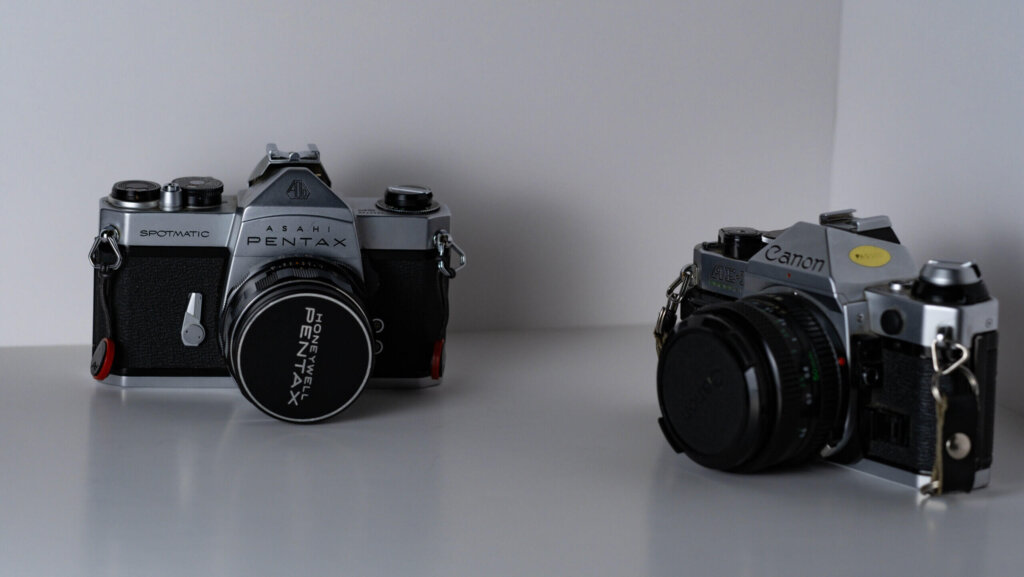
That’s the appeal for me. Film makes me slow down. Every shot is more expensive than digital. You can’t just spray-and-pray, like with digital cameras. So, I have to think before I press the shutter button. My current lineup is two cameras: a Canon AE-1 Program my father-in-law gave me (he calls it a loan, I call it mine now), and a Pentax Spotmatic that came from Christian, aka C.J. Juarez Photography on Instagram, who had no use for it anymore. I didn’t need my arm twisted.
The spark for this post came from one of the guys in Driving While Awesome, Lane Skelton, who showed up with a Contax RTS. Any time someone pulls out a camera I don’t own, I get a little excited, because I know they appreciate it and I know they’re having fun with it. The fun fact that hooked me: the RTS was styled by Porsche Design. Two brands working in conjunction to make something sleek, and it shows. That got me thinking about whether the RTS deserves a spot in my lineup, or at least deserves the thought experiment.
The Three Cameras
Quick positioning before the comparison. The Spotmatic is fully mechanical, no electronics involved beyond the light meter, which doesn’t work on mine anyway, so I meter with an app or a handheld meter. The AE-1 Program is the opposite end: without batteries, you have no shutter and no exposure at all, this is early-electronics-in-cameras territory. The RTS sits in the middle in terms of era but ahead of both in intent. It’s electronic, but the electronics were built for professional reliability, a shutter that’s electronically controlled and accurate. Two of these are consumer cameras. One was built as a professional tool.
Viewfinder And Metering
The RTS wins the viewfinder conversation outright, best and brightest of the three, with manual focusing that’s supposed to be a genuine pleasure through Zeiss glass. Second place goes to the Spotmatic, and the AE-1 Program brings up the rear, though honestly the viewfinder has never bothered me on either of the two I actually own.
Metering is where the Spotmatic disqualifies itself, since mine doesn’t function. The AE-1 Program has open-aperture TTL metering that works in program and shutter-priority modes, and it’s dead simple: red light in the viewfinder means you’re off, green means you’re set. The RTS uses center-weighted TTL metering, built for professionals, and it’s presumably very accurate when it’s working.
The Lens Systems (The Real Deciding Factor)
This is where it gets interesting, because I think the glass matters more than the body. The Spotmatic runs on the M42 mount, which opens the door to Super Takumars, some Meyer-Optik glass, Soviet lenses that plenty of people swear by, and a long list of vintage options. It’s a great ecosystem. The AE-1 Program uses Canon’s FD mount, excellent optics, a huge selection, and you can find good glass for genuinely good value. The RTS runs Zeiss glass, and Zeiss has a reputation that needs no introduction given its history with Leica. There are legendary lenses in that lineup built for manual focus, and that alone should make the RTS a joy to shoot.
Shooting Experience And Reliability
The Spotmatic is the slowest of the three to shoot with, since I have to meter independently rather than through the camera. That extra step makes it more thoughtful, more tactile, more hands-on than the other two. It’s also the reason I love it. The AE-1 Program is faster and more convenient, though still slow by digital standards since metering is still on you. It’s a genuinely great camera for beginners because of how easy it is to use, and the kit lens quality isn’t far off from what I get out of the Spotmatic. The RTS, from what I’ve seen, is smooth and confidence-inspiring, everything feels engineered rather than assembled.
On reliability, the Spotmatic wins by virtue of being mechanical: nothing fails except the meter, which is exactly what happened to mine. The AE-1 Program is known for developing the “Canon squeal,” an aging and lubrication issue in the mirror mechanism that’s repairable but common knowledge among film shooters. The RTS is generally reliable, but the electronics mean repairs get expensive if something fails today.
Pricing, roughly: Spotmatic runs $100 to $250, AE-1 Program runs $200 to $350, and the Contax RTS lands between $300 and $700 based on what I’ve seen.
The Car Analogy
I couldn’t resist drawing the parallel, because that’s how my brain works. The Spotmatic is a classic Land Cruiser, an early 911, or a 240Z if you want to keep it with the same country of origin: durable, mechanical, repairable. The AE-1 Program is a Honda Civic, mass-market engineering done well, but still mass-market. Nothing wrong with a classic Civic. They were everywhere at the time and they’re becoming classics now, same as the AE-1 Program. The RTS, I’d call a Mercedes W124, maybe stretch it to a 500E, the Hammer, if you want the fully dressed-up version. Luxury, with an edge.
Would The RTS Make The Cut?
Here’s where I landed. The Spotmatic is mechanical, simple, dependable. The AE-1 Program was convenient and, in its time, made photography accessible to everybody. The RTS is probably one of the best manual-focus experiences you can get out of a film camera, and the real question isn’t whether the body is nice, it’s whether the Zeiss ecosystem offers me something fundamentally different. The more I shoot, the more I notice that glass matters more than the body, especially on film. So yes, I think the lens system alone would be worth experiencing.
Would it earn a unique role in the lineup? I’m not sure yet. I’d need to actually shoot with one before I could answer that honestly. But if I had to pick only one camera between the three, the RTS is the strongest challenger. If I’m being fully honest about what I actually want, it’s something with the reliability of the Spotmatic and access to the Zeiss platform, minus the electronics. That’s the sweet spot I’m chasing, and I haven’t found it yet.
Props to Lane for putting the RTS back on my radar. Sometimes all it takes is seeing a camera on someone else’s Instagram story to reconsider something you’d written off.
Thank you for stopping by,
DL
Discover more from 3DLANES
Subscribe to get the latest posts sent to your email.