This post is a companion to the latest 3DLANES podcast episode.
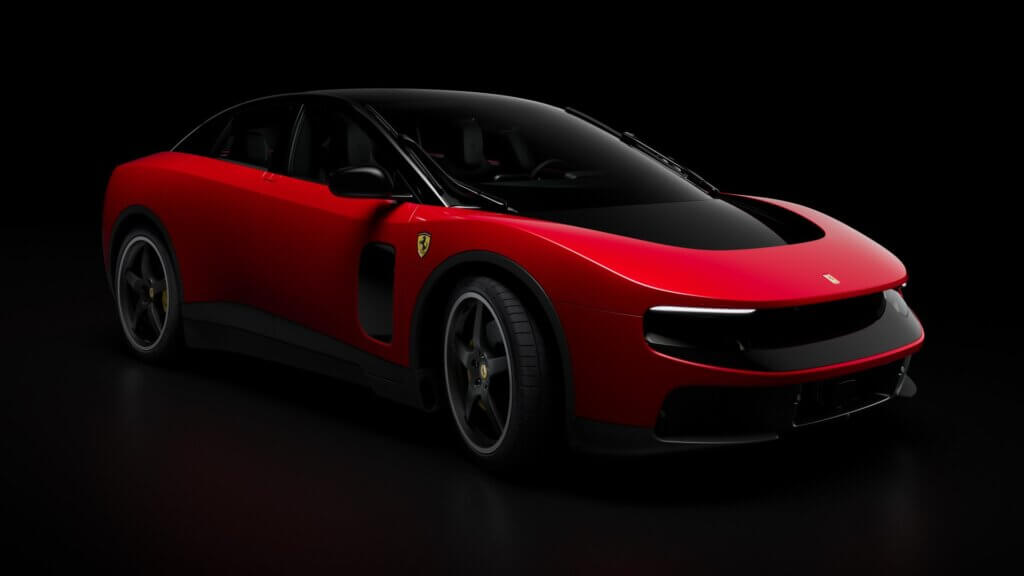
Ferrari’s Luce has been the topic of the car enthusiast community for weeks, and most of that conversation has stopped at “it’s ugly.” That reaction is fair enough, but it’s not the interesting part. The interesting part is what Ferrari is actually doing with this car, and why a company that has never needed to explain itself to anyone is suddenly making moves that look aimed at buyers who have never owned a Ferrari at all.
What The Luce Actually Is
The Luce is a low-volume, ultra-expensive, fully electric four-door. Four doors, five seats, around 1,000 horsepower, a top speed near 190 mph, and a price around €550,000, roughly $640,000. None of that reads like a typical Ferrari on paper, and it isn’t supposed to. This is Ferrari’s first five-seater and its first EV, built for ultra-wealthy clients that include families, not just the usual buyer.
The usual buyer, for reference, has been high-net-worth, predominantly male, 35 to 55, chasing performance and motorsport heritage in a two-seater or 2+2. That’s decades of brand identity. The Luce doesn’t replace that customer. It goes looking for a different one.
Who Ferrari Is Actually Chasing
CEO Benedetto Vigna told Reuters the Luce is seeing strong interest “from new and existing customers.” New is the word that matters. CNN describes it as a car aimed at affluent families. Observer reports “robust interest from new ultra-wealthy buyers,” people Ferrari has been trying to recruit for a while, especially in China.
Ars Technica puts a finer point on the geography: Ferrari framed the Luce as the answer for markets like China and Silicon Valley that expect, or increasingly require, an emissions-free option. That’s not a car for the 50-year-old enthusiast with a garage full of V12s. That’s a car for a tech-savvy buyer in a regulation-heavy market who wants the badge without the tailpipe.
China is the market to watch here. BBC reported Ferrari built the Luce, in part, to compete with the wave of Chinese EV makers who have zero competition at home. A Ukrainian outlet reported that every Luce allocation for China sold out instantly, criticism and all. That’s not a company testing the water. That’s a company that already knew who was buying before the car was unveiled.
Ferrari’s Electrification Math, And Why It Keeps Moving
Ferrari’s electrification targets have shifted more than once. The 2022 plan called for 40% fully electric and 40% hybrid by 2030, with 20% ICE. That target has since been revised to 40% ICE, 40% hybrid, and only 20% fully electric, a more conservative EV bet than Ferrari originally signaled. Ferrari is also building an “e-building” at Maranello to assemble motors and battery packs in-house, and has committed to carbon-neutral operations by 2030.
Read that as a company hedging in both directions. Ferrari isn’t abandoning the V6, V8, or V12, and it isn’t skipping electrification either. It’s keeping every door open, which is exactly what you’d expect from a brand that has never had to bet the whole company on one powertrain.
The Reception Was Split, And That Split Tells You Something
The exterior got hammered. CNN quoted critics calling it “like a Nissan Leaf.” Former Ferrari chairman Luca di Montezemolo said it risks “destroying a legend” and suggested Ferrari remove the badge from it entirely. The New York Times ran an opinion piece titled, essentially, “it’s ugly, it costs $640,000, and everyone is mad about it but me,” which is its own kind of headline.
But the interior got the opposite treatment, near-universal praise for the materials and the way modern tech was blended with Ferrari’s design heritage. That split matters more than either extreme on its own. The exterior backlash is coming from enthusiasts and traditionalists, the exact audience this car was never fully built for. The interior praise is coming from people evaluating it as a luxury product on its own terms. Two different audiences judging two different things, and Ferrari built the car for one of them.
Ferrari’s stock dropped over 8% on the Milan exchange after the reveal, wiping out around €5 billion in market value. Shares stabilized shortly after, and analysts turned mostly positive again. That’s a market having an emotional reaction to a design, then remembering it’s still Ferrari.
The Access Question
There’s a less flattering thread here. Bloomberg-sourced reports, picked up by outlets like The Drive, allege Ferrari or its dealers have nudged existing clients toward ordering the Luce to improve their odds of getting access to future limited models. Ferrari’s CMO publicly denied that buying a Luce is required for anything. Whether or not the allegation holds up, the fact that it’s plausible enough to report says something about how Ferrari has historically managed client relationships: buy the car we tell you to buy, and maybe you get the car you actually want next.
Luce vs. Taycan, And The Watch World Comparison
The Porsche Taycan is the obvious EV comparison, and it’s useful precisely because of how far apart the two cars sit.
| Ferrari Luce | Porsche Taycan | |
|---|---|---|
| Price | ~€550,000 (~$640,000) | A fraction of that, across trims |
| Power | ~1,000 hp, four motors | Lower, varies by trim |
| Top speed | ~190 mph | Lower, varies by trim |
| Range | 300+ miles | ~250–300 miles |
| Role in lineup | Low-volume halo, exclusivity play | High-volume cornerstone of Porsche’s EV strategy |
The Taycan is built to be Porsche’s electrified backbone. The Luce is built to be the opposite: a low-volume, high-exclusivity statement that happens to be electric. Same category, opposite job.
That gap is basically the Rolex-versus-Patek Philippe conversation we’ve had on this show before, just with a badge and four wheels instead of a bezel. Porsche has scale and accessibility even at the high end; if you’re persistent and have the means, you can get one. Ferrari has never played that game, and the Luce doesn’t change that. It just moves the exclusivity into a new powertrain.
Is This Diversification?
I keep coming back to this question, and I don’t think I land cleanly on either side. On one hand, a four-door EV aimed at affluent families is a real departure from Ferrari’s core product. On the other, Ferrari isn’t wandering off into an unrelated category the way Jaguar or Kodak did when they lost the plot. It’s still selling the same thing it’s always sold: exclusivity, engineering, and a badge that means something to the person writing the check. It’s just selling that to a buyer who previously had no reason to consider Ferrari at all.
CBC put it well: traditional enthusiast outrage might not matter if ultra-wealthy buyers accept the car, and if it moves Ferrari closer to its regulatory and environmental targets. Ferrari doesn’t need every car enthusiast to like the Luce. It needs the small number of people who can write a $640,000 check to want one, and early signs, especially out of China, say they do.
Whether this becomes a real second pillar for Ferrari or a low-volume experiment that quietly fades depends on something none of us can measure yet: whether these new buyers stick around for the next car, or whether the Luce was just a curiosity purchase for people testing the badge for the first time.
Thank you for stopping by,
DL
Discover more from 3DLANES
Subscribe to get the latest posts sent to your email.