This post is a companion to the latest 3DLANES podcast episode, and derived from its transcript.
Every time a heritage brand does something even slightly different, the internet loses its mind. We saw it with the Ferrari Luce. We saw it with the Singer and Louis Vuitton collaboration. And we saw it, in a big way, with the Rolex Land-Dweller. I want to look back at that one specifically and ask a simple question: did it earn the criticism, or did we just do what we always do when change shows up wearing a crown?
Let me be clear here, my purpose is not to provide a clean answer. Rolex doesn’t publish unit sales, sell-through numbers, or anything close to real performance data. So, any conclusion here is built on watch media reaction, forum sentiment, and secondary market listings, not sales figures. Items to keep in mind as we go.
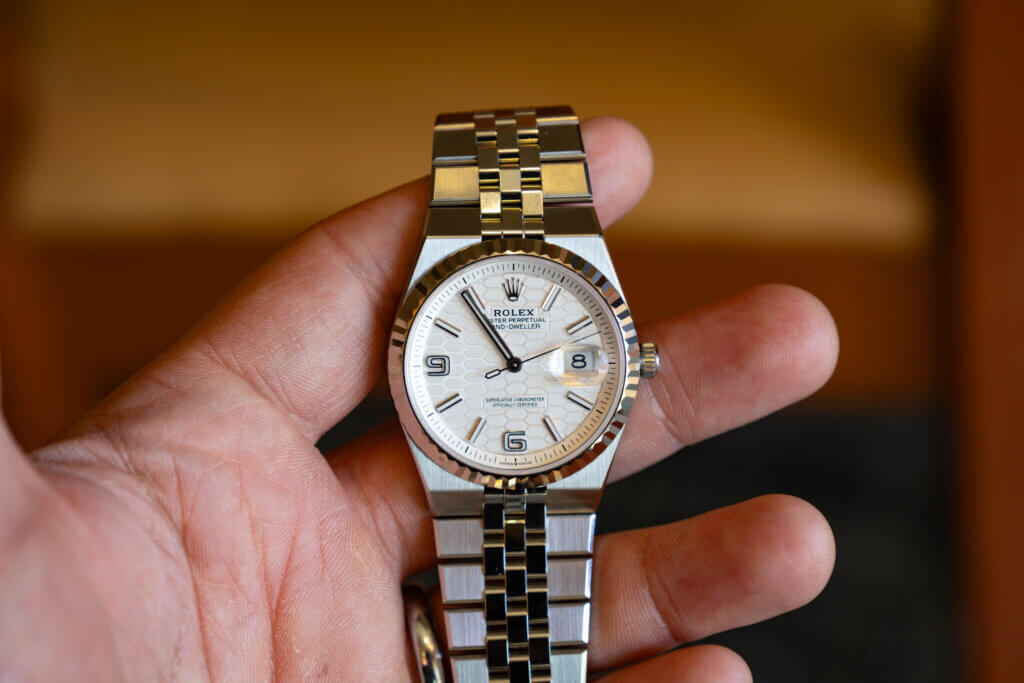
What The Land-Dweller Actually Is
For anyone who missed the launch, the Land-Dweller debuted at Watches and Wonders on March 31st or April 1st, 2025. It’s an integrated bracelet sports luxury watch, available in 36mm or 40mm, in Oystersteel, white gold, Everose gold, or platinum. Steel versions started somewhere between $13,000 and $14,000 (creeping toward the mid-$15,000s since), and the diamond-set versions run from roughly $88,000 to $118,000.
The headline feature is the new caliber 7135, which introduces Rolex’s first proprietary escapement, called Dynapulse. That’s not a small thing. This is the product of nearly ten years of development, and R&D head Oliver Graham has stated the escapement can theoretically function without lubrication. The movement is manufactured almost entirely from silicon using deep reactive ion etching (DRIE), and per Frank Vernet, Rolex’s head of movements, the escapement’s sequential distribution delivers roughly 30% more energy efficiency than a conventional Swiss lever escapement, without taking up more space.
That is a legit engineering achievement. It’s also not what most people talked about when the watch came out.
The Name Was The First Problem
Before anyone saw the watch, they saw the trademark filing. Rolex trademarked “Land-Dweller” and “Coast-Dweller” on July 20th, 2023, and enthusiast forums caught fire immediately. The complaint was straightforward: Sea-Dweller and Sky-Dweller describe environments where those watches provide a real functional advantage (depth resistance, altitude, dual time zones). Land-Dweller basically means… standing on the ground. Which is where almost every watch spends its life. The name didn’t signal a capability. It signaled a category, and not a flattering one.
Then People Saw The Case
Once the watch itself surfaced, the comparisons started stacking up fast. The case was compared to the Rolex Oysterquartz reference 1530/17000 (1975 to 1977), the Tissot PRX, the Cartier Santos and Pasha, the Piaget Polo, and the Audemars Piguet Royal Oak. Enthusiasts also pointed out, correctly, that Rolex wasn’t first to this shape. Omega and IWC were doing integrated-bracelet quartz cases in the early 1970s, before the Oysterquartz even existed. Some people called it Rolex’s ugliest watch. Rolex, to its credit, didn’t dodge any of this. The brand confirmed the case revives the 1975 reference 1530 with slight proportional tweaks, and leaned into the historical lineage rather than pretending it invented the shape from scratch.
The Price Problem
Here’s where the criticism got more substantive than “it looks like other watches.” The Land-Dweller has no complication. It’s a time-and-date watch. And at 40mm, the steel version lands close to $15,000 to $17,000 with tax, which puts it right next to the Sky-Dweller at around $16,000, a watch that actually does more (dual time zone, annual calendar). People weren’t wrong to ask why a simpler watch was priced that close to a more complicated one. That’s not enthusiast nitpicking, that’s a legitimate value question.
What The Watch Actually Got Right
Not everyone piled on. Watch journalists praised the caliber specifically, with at least one calling it Rolex’s most important new model in decades, largely because of the Dynapulse escapement and the DRIE manufacturing process behind it. Independent watchmaker Rexhep Rexhepi reportedly told Hodinkee that the watch is extremely important and that he’d personally want to own one. That’s not nothing. Someone whose job is building movements, saying the movement matters, should matter.
And there’s a pattern worth noting in how sentiment moved after launch. Enthusiasts who actually went hands-on, not journalists, just regular collectors on Reddit and in forums, kept repeating some version of the same line: the more I looked at it, the more it grew on me.
We’ve Seen This Movie Before
This is the part of the episode I keep coming back to, because it isn’t the first time Rolex has done this. The Sky-Dweller launched in 2012 to criticism that its Ring Command system was overcomplicated and hard to use, and that the dual time zone display was too small. Fast forward to 2026, and retailers describe it as one of the rare underappreciated models in the lineup, with steady demand and wait times between one and five years for certain steel variants.
The Yachtmaster tells a similar story. Launched in 2007, it got hit for a busy dial, an oversized bezel and case proportions, and it eventually got discontinued and treated as an outlier next to Rolex’s cleaner dials. Years later, Reddit threads are still asking why it’s hated, while other fans call it underrated and say the 100-meter water resistance criticism comes from people who will never dive an inch below their bathtub.
Same pattern both times: technical or design ambition draws immediate skepticism, and the sentiment softens over years, not months. Will that happen with the Land-Dweller? I don’t know. But previous cases show that it might be a plausible option.
What We Actually Know (And Don’t)
On the commercial side, there’s genuinely not much to work with. Rolex doesn’t publish sell-through data, full stop. Secondary market listings from Chrono24 have put the 40mm between $30,000 and $36,000 through 2025 and into 2026, and Watchguys reported a similar range, with the 36mm between $24,000 and $28,000. There are also contradicting reports about demand softening, some sources claim prices dipping below $20,000, while a June 2026 report from Luxury Bazaar described demand as still very high. I’m not going to pretend I know which of those is right until harder data is available.
What we don’t know, and probably won’t know for a while: whether Rolex intends the Land-Dweller as a Datejust alternative, a new standalone pillar collection, or a test bed to prove out Dynapulse before rolling it into other models. Rolex hasn’t said, and it probably won’t until the next model wearing that movement shows up.
Why We React Like This
Here’s the actual question underneath all of this, and I’m asking it as an enthusiast pointing the finger at myself as much as anyone else: why do we default to a negative reaction when a legacy brand changes something, even when the change comes with real technical merit? The Land-Dweller launched with arguably the most significant in-house escapement innovation Rolex has produced in decades, and the loudest initial reaction was about a case shape and a name. That’s a strange set of priorities when you say it out loud.
There is no clean conclusion here. I think it’s worth sitting with the discomfort of it rather than resolving it too quickly. If you’ve got a take on the Land-Dweller, or on the Singer collaboration, or any of these polarizing releases, I’d genuinely like to hear it. This is a good discussion, and it’s one I plan on revisiting on the website as more of these episodes get their companion posts up.
Thank you for stopping by,
DL
Discover more from 3DLANES
Subscribe to get the latest posts sent to your email.