TThis post is a companion to the latest 3DLANES podcast episode.
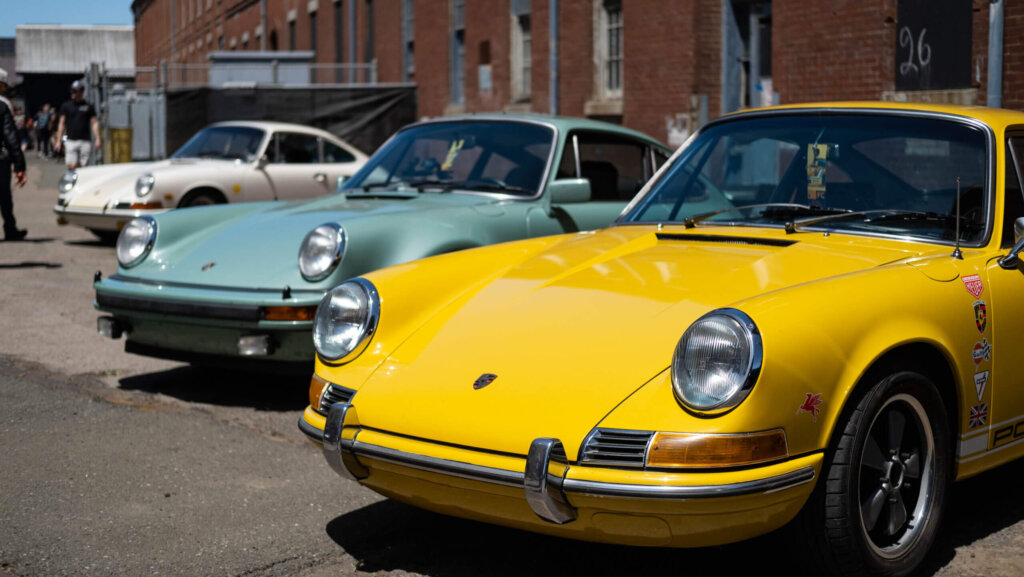
The 911T is essentially the 912’s spiritual successor, Porsche’s way of keeping an entry point in the lineup without dragging the 911 name through the mud. Three iterations of the 911T exist, but we’re only covering two here.
The idea was simple: give enthusiasts access to the flat-six without charging the full premium. Development ran from ’67 to ’68, production lasted until ’73 for the first generation. It replaced the 912’s four-cylinder and gave Porsche a way to go after a broader audience without diluting the top of the lineup.
To hit the price, Porsche went cheaper on materials. Cast iron cylinder heads instead of aluminum. 2.0-liter flat-six making 110 hp, the 911L was pushing 130. Four-speed manual where the others got five. The tradeoff? It was actually lighter than most variants, only the S beat it there. Zero to 60 in the 8.3-second range. Not fast by today’s standards, but not the point either.
Handling was genuinely good, and it was capable enough to race.
Production run
B-Series (1969): Big changes. Wheelbase grew by 57mm to 89.4 inches, which made a real difference in handling and weight balance. Flared arches went on to fit wider 5.5-inch wheels. A Comfort package let buyers spec the interior up to 911E levels if they wanted it.
C and D-Series (1969–1971): Production ramped up significantly, 15,082 units across this stretch. Power climbed to 125 hp and eventually 130 hp, narrowing the gap with the mid-range models considerably.
E-Series (1972): 8,238 units. Refinements to keep up with safety and emissions requirements.
F-Series (1973–1973.5): Final year of the original run, 8,695 units. Midway through ’73, U.S. cars switched to Bosch K-Jetronic CIS fuel injection, which is why the “1973.5” spec is so sought after. Bigger impact bumpers came along too for the 2.5 mph crash standards. Collectors love these late ones.
Total production across the full run: roughly 39,248 units. That makes it the highest-volume early 911 variant by a considerable margin.
Motorsport Heritage
The 911T had serious success in rallying. It dominated Group 3 GT competition and won the Monte Carlo Rally back-to-back in ’68 and ’69. For homologation purposes, Porsche built roughly 35 examples of the 911T/R in 1967, stripped down, rally-kitted, customer-specced machines.
Classic Porsche playbook: win races, let the motorsport story do the marketing. Even the entry-level 911 was beating people. Hard to argue with that.
The Modern Revival (2018–2019)
Porsche brought the T back in 2017 with the 991.2 generation, a 911 built around the act of driving, not the list of features. They added performance where it mattered and deleted everything that didn’t.
The 2018–2019 Carrera T came with a 3.0-liter twin-turbo flat-six making 370 hp, rear seat deleted, thinner glass, less sound deadening. PASM Sport Suspension, Sport Exhaust, and Porsche Torque Vectoring all standard. Seven-speed manual with a shorter shift lever standard, PDK optional. Base price was $103,150, slotted right between the base Carrera and the S.
Production estimates sit under 3,000 units globally, which kept the exclusivity story intact while honoring what the original was actually about.
4P Analysis
Product
The 911T is a masterclass in deliberate reduction. Porsche didn’t make it cheap, they made it intentional. Perlon carpeting, steel disc wheels (Fuchs alloys were optional), no wood trim, simplified interior, four-speed gearbox. Every omission was a choice.
The performance ladder across the early lineup:
| Model | Power | 0–60 | Weight | Position |
|---|---|---|---|---|
| 911T | 110–130 hp | 8.3 sec | 2,381 lbs | Entry |
| 911E | 158 hp | 7.0 sec | 2,410 lbs | Mid |
| 911S | 160–190 hp | 6.5 sec | 2,330 lbs | Top |
The T/R homologation variant took the reduction further, no sound deadening, rally kit, competition suspension and fuel systems, customer-specified from the factory.
Lifecycle-wise: 1968 was the intro, 1971 was when it hit its stride, 1973 was maturity.
Price
Base price in 1969: $6,315. That’s roughly $56,000 in 2024 dollars. It sat 20–25% below the 911S and carried about a 20% premium over the 912 it replaced.
Three objectives, cleanly balanced: expand the market, preserve margins through shared components, and create a clear price-performance ladder across the lineup. It worked.
The 2018 revival worked differently. Starting at $103,150, options pushed real-world pricing to $130–135K. The value pitch was different too, 80% of the performance, 95% of the prestige, 100% of the racing heritage, at 75% of the cost. Scarcity did the rest.
Place
Distribution in the ’60s and ’70s was a patchwork that evolved as Porsche figured out the U.S. market:
- 1950–1954: Max Hoffman ran it exclusively as U.S. importer
- 1955–1963: Porsche of America Corporation built out an independent sales network
- 1963–1969: Porsche took over direct importation, moved HQ from New York to Teaneck, New Jersey
- 1969–1984: The Porsche-Audi Division under Volkswagen of America managed distribution through 14 wholesalers and 150 dealerships
The modern approach is dealer allocation management, limited production, allocations tied to customer relationships. It’s a different game entirely.
Promotion
In the late ’60s and early ’70s, motorsport was the marketing. The rally wins weren’t just racing results, they were proof points. Porsche backed factory programs for customers who wanted to race, and print media carried the story. Clean and effective.
Today it’s social media, Porsche Experience Centers, and scarcity messaging. Limited allocations drive urgency and perceived value. The product hasn’t changed philosophically. The megaphone has.
Thank you for stopping by,
DL
Discover more from 3DLANES
Subscribe to get the latest posts sent to your email.