October 1981.
The manual-focus SLR market was mature, crowded, and tightening. Feature differentiation was incremental, competition was fierce, and margins were compressing. Minolta needed a camera that could defend its position in the mid-tier consumer segment without overextending into professional territory.
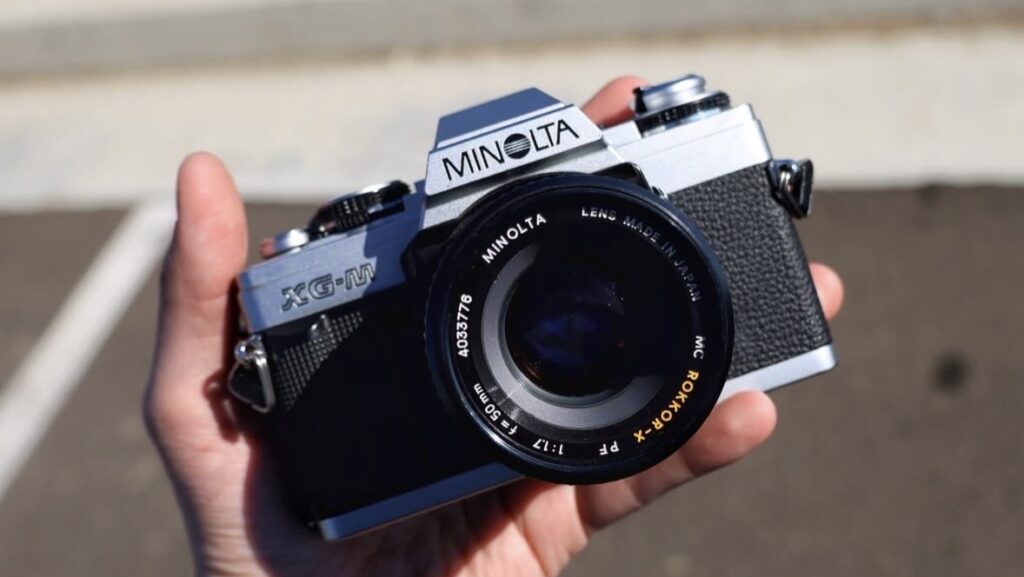
Enter the Minolta XG-M, marketed in Japan as the X-70 and arriving there in 1982, directly replacing the XG-9 (1979). The “M” stood for Motor Drive 1 compatibility, signaling one of its strategic upgrades: bringing motorized shooting capability deeper into the consumer market.
What Triggered Its Development?
By the early 1980s, the SLR market had peaked in many developed regions. Growth was slowing. Demand still existed but it was competitive demand.
Minolta faced several pressures:
- Escalating competition from Canon, Nikon, Olympus, Pentax, and internal rivals.
- Feature escalation, especially motor drives and improved metering.
- Customer dissatisfaction with the XG-9’s lack of metering in manual mode.
- Brand repositioning, including a corporate logo redesign and updated body styling.
The XG-M addressed a clear usability gap: it introduced metered manual exposure while retaining aperture-priority automation. That dual-mode flexibility positioned it as both accessible and instructive.
It wasn’t a radical innovation, it was a corrective evolution.
Key Specs:
| Feature | Specification |
| Format | 35mm full-frame (135 film) |
| Lens Mount | Minolta SR bayonet (MD/MC compatible) |
| Exposure Modes | Aperture-priority auto, metered manual |
| Shutter | Horizontal cloth focal plane, 1s–1/1000s + Bulb |
| Metering | Center-weighted average, CdS cell, TTL |
| ISO Range | 25–1600 |
| Viewfinder | 93% coverage, Acute-Matte™ screen, split-image/microprism |
| Flash Sync | 1/60s, hot shoe + PC sync |
| Exposure Compensation | ±2 EV in ½-stop increments |
| Weight | ~515–531g (body only) |
| Motor Drive | Motor Drive 1 (3.5 fps) or Auto Winder G (2 fps) |
What Challenges Were Faced?
The Canon Effect
The Canon AE-1 had already reshaped the consumer SLR market. Canon didn’t just sell automation, it marketed accessibility at scale. Heavy advertising investment created cultural dominance.
Minolta’s response was feature refinement rather than marketing escalation. That difference mattered.
Internal Cannibalization
The XG-M sat dangerously close to the Minolta X-700 in price.
| Model (1982 Street Price) | Body Only | With 50mm |
|---|---|---|
| XG-1(n) | ~$139.90 | — |
| XG-M | ~$189.90 | ~$250–$290 |
| X-700 | ~$223.90 | ~$240–$300 |
| XD-11 | ~$299.90 | — |
For a relatively small price increase, the X-700 offered greater capability. In a value-sensitive segment, that narrow gap complicated the XG-M’s positioning. This is a classic mid-tier squeeze: Too advanced for entry-level. Too close in price to semi-pro.
Reliability Issues
Electrolytic capacitor failures are now a well-known weakness of the XG-M. Over time, leaking capacitors can damage the Circuit Board or render the camera inoperable.
While this wasn’t immediately catastrophic at launch, long-term durability affects brand perception, particularly in a market where mechanical longevity was expected.
Relevance in the Photography World
This camera body was the template for Minolta’s golden era. It became the standard until the end of the manual focus era. An ideal learning camera, up until today, this camera is regarded as a great learning tool.
The Minolta XG-M has endured to the renaissance of film photography. Film photography has experienced a strong resurgence since the 2010’s and is still going strong. This camera represents a very affordable entry point to film photography.
The XG-M is a great gateway for the Minolta lens ecosystem. The lenses made by Minolta are great quality and not easily ignored. If you can get in into the ecosystem, these lenses are great tools for the trade.
4P Analysis
Product
A feature-corrected evolution of the XG-9. Added metered manual mode and motor drive compatibility. Positioned as an advanced consumer SLR.
Price
Compressed between entry-level and semi-pro models. Close proximity to the X-700 weakened its value differentiation.
Place
Distributed through traditional camera retailers at a time when physical shelf presence defined market visibility. Today, the secondary market (eBay, KEH, Kamerastore, etc.) functions as its new distribution ecosystem.
Promotion
Advertising in the early 1980s remained print-driven. Compared to Canon’s aggressive consumer marketing. In the present era, rediscovery happens through blogs, YouTube, podcasts, Reddit, and word-of-mouth.
What are your thoughts on the XG-M? Let me know in the comments.
Thank you for stopping by,
DL
Discover more from 3DLANES
Subscribe to get the latest posts sent to your email.