A Solution Without a Problem
This post is a companion to the latest 3DLANES podcast episode.
The deadbeat seconds complication did not start as a luxury feature. It started as a fix.
In 1675, English astronomer Richard Towneley introduced the deadbeat escapement to eliminate recoil in precision clocks at the Greenwich Observatory. Recoil created inconsistencies. Time did not advance cleanly, it fluctuated.
The solution was simple in concept: instead of a sweeping motion, the seconds hand would advance in precise one-second intervals.
Later, in 1715, English watchmaker George Graham refined the system. The improvement was so effective that the escapement became known as the Graham escapement, and clocks using it became regulators—tools built for accuracy, not aesthetics.
Miniaturization: From Observatory to Wrist
Turning a regulator concept into a wristwatch was not a natural evolution, it was an engineering challenge.
A few brands attempted it:
- Rolex with the Tru-Beat
- Omega with the Synchrobeat
- Additional attempts from Doxa and Zenith
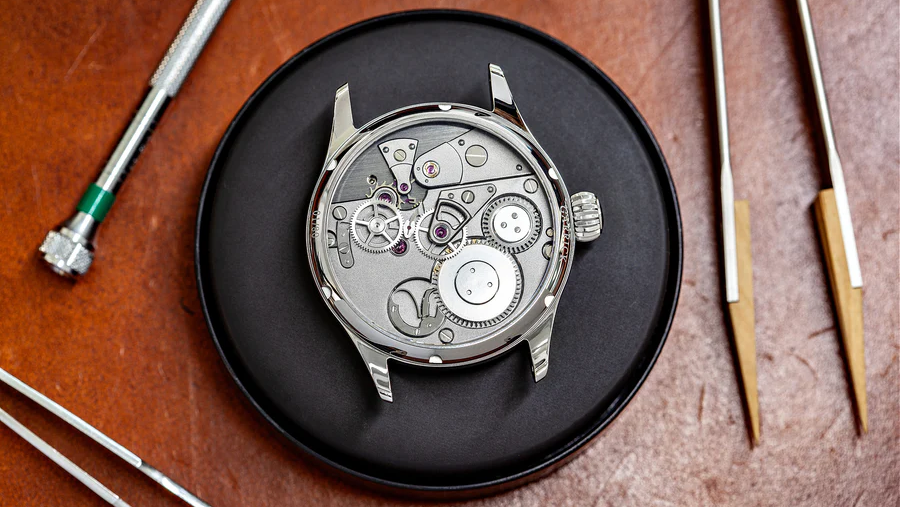
The goal was the same: convert a high-frequency mechanical movement into a clean, one-second tick.
Rolex achieved this by modifying a 4Hz movement to produce discrete one-second jumps. Omega’s approach was less successful. Manufacturing issues led to recalls, with very few pieces believed to remain.
Engineering Approaches
There was no single solution to achieve deadbeat seconds in a wristwatch.
- Star and flirt mechanisms
- Secondary escapements
- One-second remontoire systems
Each added complexity. None simplified the watch.
Why It Disappeared
The deadbeat complication solved a real problem… in clocks.
It did not solve one in wristwatches.
Clocks relied on pendulums, where recoil affected isochronism. Wristwatches use balance wheels. The problem was already gone.
What remained was a visual behavior, a ticking seconds hand—with limited functional advantage.
The market responded accordingly:
- High servicing complexity
- Limited parts availability (many pieces were converted back to standard movements)
- Consumer confusion during the rise of quartz in the 1970s
- Declining demand from professionals
What started as a precision tool became an unnecessary complication.
4P Analysis
Product
A professional tool positioned as a luxury object.
In the case of Rolex, a 34mm Oyster case watch, chronometer-certified, built around precision timing. It predates models like the Submariner and Explorer but follows the same “professional tool” narrative.
Promotion
Targeted, not broad.
The complication was marketed to medical professionals, pulse measurement, timing procedures. Medical publications reinforced credibility.
Price
Premium, even at inception.
~$300 at the time, aligned with luxury positioning. The question was always present: does the functionality justify the price?
Today, surviving examples trade around ~$35,000, driven by rarity—not utility.
Place
Standard luxury distribution.
Authorized dealer networks, consistent with the broader Rolex model.
Thank you for stopping by,
DL
Discover more from 3DLANES
Subscribe to get the latest posts sent to your email.