This post is a companion to the latest 3DLANES podcast episode.
I picked three brands for this one: Rolex, Omega, and Ming. Not because they’re my favorites, not because they’re more interesting than anyone else out there, they just happened to be the three that popped into my head when I started thinking about the question. You could run this same exercise with any brand, any day of the week. That’s kind of the point.
The question I’m actually asking is simpler than it sounds: does a brand have a competitive advantage, and if it does, can it keep it? Those are two different problems. A lot of brands manage the first one. Fewer manage the second.
The Framework
Most people don’t reverse-engineer why they’re drawn to a watch brand. Watch purchases are emotional, and that’s fine, you can buy whatever you want, scarce or not, famous or not, none of that is a requirement to enjoy a watch. But if you want to actually understand where a brand sits in the market, there’s a way to break it down.
Establishing a competitive advantage comes down to two things:
- Relevance: do people care about the brand? Do collectors know it? Do people who aren’t even into watches know it?
- Scarcity: is it hard to get? And scarcity isn’t just about limited production. It can show up in a lot of forms.
A brand needs both. Relevance without scarcity is just a well-known name anyone can buy into. Scarcity without relevance is just an object nobody’s chasing.
Sustaining that advantage is a separate question, and it comes down to three more:
- Durability: has it survived real disruption? Quartz crisis, smartwatches, recessions, a global pandemic?
- Transferability: can a competitor buy what this brand has? Sponsorships, ambassadors, distribution deals, anything with a price tag is transferable.
- Replicability: can a competitor build the same thing from scratch, given enough time and money?
Low transferability and low replicability are good things here. If someone can buy or copy your advantage, it was never really yours.
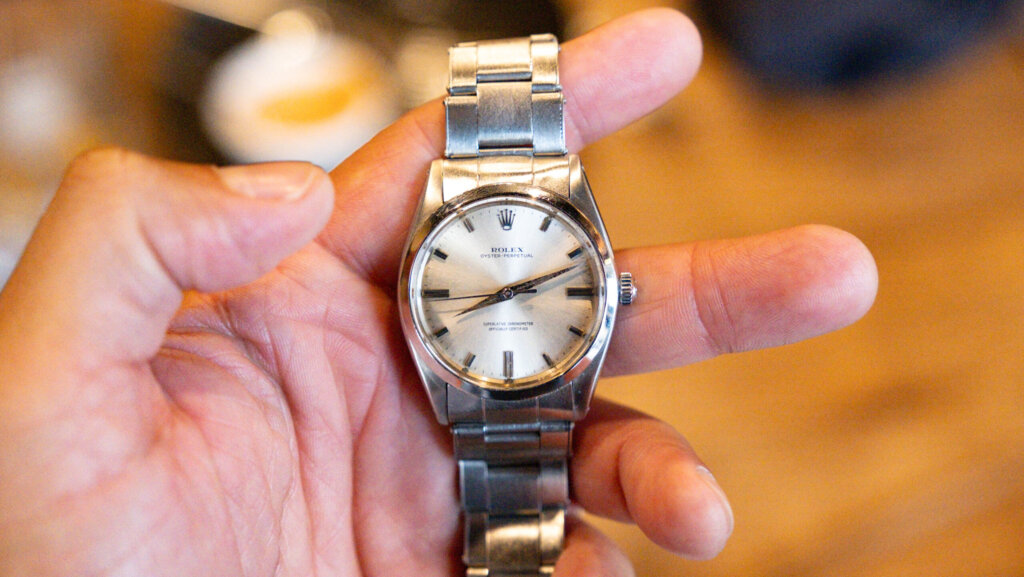
Rolex: The Easy Case
Rolex is relevant. Everyone knows Rolex, collectors, casual buyers, people who couldn’t tell you what a movement is. That’s decades of brand management, and it’s earned them what I’d call cultural relevance, not just industry relevance.
Scarcity is also high, and this is the part people get wrong. Rolex isn’t scarce because they can’t make more watches. They absolutely could ramp up production tomorrow. They don’t, because scarcity is the strategy. It’s a lever, and they know exactly how hard to pull it.
So yes, competitive advantage: established. Is it sustainable?
- Durability: about as high as it gets. Rolex survived the quartz crisis, survived smartwatches trying to eat the category, survived 2008, survived Covid, actually came out of Covid stronger.
- Transferability: low. You cannot buy a hundred years of brand history. Reputation like that isn’t for sale.
- Replicability: very low. Someone could theoretically start a brand today and try to build “the next Rolex,” but trust and recognition take years, and Rolex has also been at the front of real technical development at points along the way. That’s not a checkbox a new brand fills in overnight.
Rolex has a sustainable competitive advantage. Not really a controversial take, but it’s worth understanding why, instead of just accepting it as a given.
Omega: Strong, But Not Ironclad
Omega is the brand most people think of right after Rolex, and it has real relevance to lean on, the Moonwatch, the Olympics, James Bond. Strong heritage. But it’s not universal the way Rolex is. Plenty of people outside the hobby have never heard of it.
Scarcity is where Omega drops off. Some references are genuinely hard to get, but a lot of competitors are offering comparable finishing and movement quality at similar price points, so the differentiation is thinner.
- Durability: high. Omega has weathered its own downturns, including the 90s, and the Bond and Olympics associations have kept it in front of people consistently.
- Transferability: moderate, and this is the interesting part. Sponsorships can be bought. Other brands are already going after that same territory; Bremont’s space-program positioning is a good example. And James Bond could, in theory, switch watch brands tomorrow. That association isn’t Omega’s to keep forever.
- Replicability: moderate to slightly easier than Rolex. Customers cross-shop Omega against Tudor, Grand Seiko, IWC, and Breitling, mostly around the same price bracket, which means there’s more room for a competitor to come close.
Omega has a competitive advantage. It’s real, but it’s not as fortified as Rolex’s, and the gap shows up specifically in transferability.
Ming: The Niche Bet
Ming is relevant, but only inside the watch enthusiast bubble. Someone outside the hobby has no idea what Ming is or why it matters, and that’s fine, that’s the audience they’re built for.
Scarcity, though, is unambiguous. Limited runs, a design language that’s genuinely identifiable, and pieces that sometimes never get made again once a run is done.
- Durability: unproven. Ming has years behind it, not decades. Rolex and Omega are elders in this industry. Ming is still early enough that durability is a question, not an answer.
- Transferability: low. You could copy Ming’s design cues, but everyone would clock it immediately. What Ming has built, the design DNA, the manufacturing achievements, isn’t something you buy off a shelf.
- Replicability: this is the mixed verdict. The engineering can technically be copied. But the community around Ming, and the founder’s reputation, are much harder to replicate. Someone could build a comparable brand with a similar approach and end up adjacent to Ming, not identical to it.
So: competitive advantage within the niche, yes. Sustainable long-term? The jury’s still out. Ming hasn’t had the runway yet to prove durability the way Rolex and Omega have.
The Comparison
| Brand | Relevance | Scarcity | Durability | Transferability | Replicability | Sustainable? |
| Rolex | High (universal) | High (by design) | Very high | Low | Very low | Yes |
| Omega | High (within category) | Moderate | High | Moderate | Moderate | Yes, but weaker |
| Ming | High (niche only) | High | Unproven | Low | Mixed | TBD |
Relevance or Scarcity, Which One Actually Matters?
Here’s the question I keep coming back to: is scarcity the real advantage, or does scarcity just protect the relevance a brand already has? I don’t think you can fully separate them, but I don’t think they carry equal weight either.
You can see the answer in the failure cases. Plenty of collaborations lean entirely on scarcity, limited editions, low numbers, hype-driven drops, and they fade fast because nobody actually wanted the thing in the first place. Scarcity without demand doesn’t create value. It just creates inventory nobody’s chasing.
I’d rather leave you with the question than a hot take, because I think it’s worth sitting with the next time you’re looking at a brand you’re drawn to. And to be clear, none of this is about buying watches as assets to flip later. That’s a different conversation, and honestly not one I think should define why anyone buys a watch in the first place.
Thank you for stopping by,
DL
Discover more from 3DLANES
Subscribe to get the latest posts sent to your email.