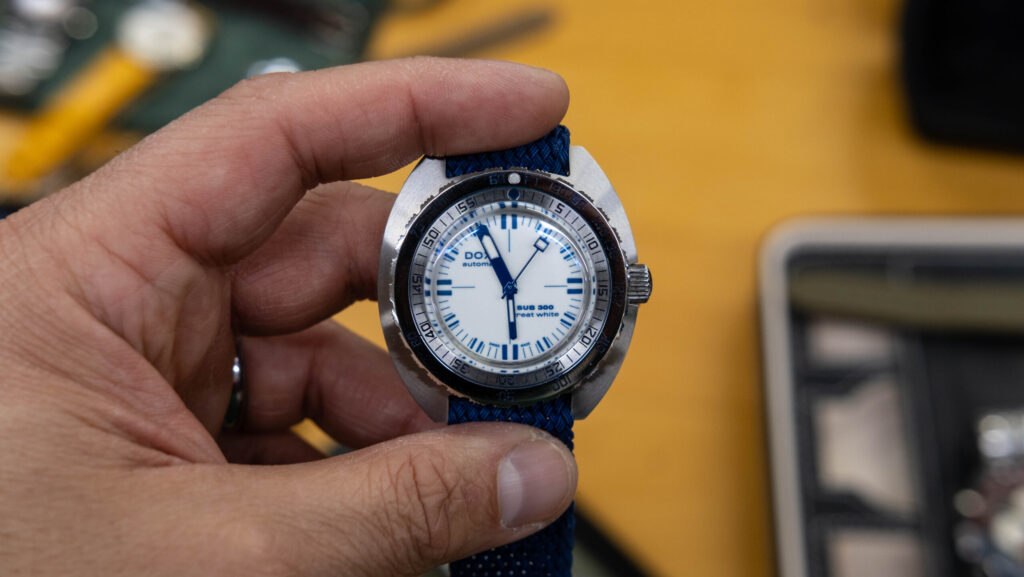
This post accompanies the latest 3DLANES podcast episode discussing DOXA, its origins, its place in dive watch history, and the competitive landscape the brand operates in today.
Brief Origin Story
DOXA was founded in 1889 in Le Locle, Switzerland by Georges Ducommun. One of 13 children, Ducommun began his watchmaking apprenticeship at the age of 13. The name DOXA is derived from the Greek word meaning “glory.”
DOXA pocket watches won honors at the World’s Fairs in Liège in 1905 and Milan in 1906. In 1907, Ducommun patented the 8-Day DOXA Caliber, a dashboard-mounted clock with an eight-day power reserve. These clocks became standard equipment in Bugatti racing cars and later found their way into ships and airplanes.
After Ducommun’s passing, the brand was passed to Jacques Nardin, grandson of Ulysse Nardin, founder of the brand of the same name. During this period DOXA developed several complications for wristwatches, including mechanical alarms, pointer dates, and later the Grafic chronograph in 1957.
In 1967 DOXA launched the SUB 300, a dive watch designed for the recreational diver community. This watch can still be found in their catalogue today. It was designed by Urs Eschle in collaboration with Jacques-Yves Cousteau’s U.S. Divers.
The watch introduced three things to the watch world: the iconic orange dial, a unidirectional no-decompression bezel, and the beads-of-rice bracelet.
The watch later evolved into the SUB 300T, which introduced the Helium Escape Valve (HEV), developed in conjunction with Rolex.
Between the 1970s and 1980s the quartz crisis nearly eliminated DOXA. Under Aubry Frères, which acquired the brand in 1978, new designs were introduced in an attempt to keep the brand alive during difficult market conditions. These designs did not resonate with the public, and production largely dissipated during this period.
DOXA was acquired by the Jenny family in 1997. The family began restoring the brand’s dive-watch DNA through faithful reissues. A pivotal turning point came in 2019 with the appointment of CEO Jan Edöcs, who brought experience from Omega and Swatch.
Porter’s Five Forces Analysis
Threat of New Entrants
Barriers to entry are relatively low in the $200–$2,000 segment. Kickstarter campaigns, contract manufacturers, and third-party movement suppliers make it easier than ever to launch a watch brand. Owning a factory is no longer required to start a watch company.
However, some barriers remain high. The Swiss Made designation is difficult to obtain. DOXA also benefits from its heritage, decades of history, and its connection to the Cousteau legacy.
Movement supply can also become a constraint. Swiss movements are produced by a limited number of suppliers, and with the rise of microbrands, competition for those movements has increased. Vendors are also becoming more selective about the smaller brands they carry.
Bargaining Power of Suppliers
Suppliers such as ETA and Sellita can have moderate power over smaller brands like DOXA.
Supply restrictions from these manufacturers could disrupt production. If movements become difficult to source, brands may struggle to meet their production targets. In DOXA’s case, that target is roughly 10,000 units per year.
Bargaining Power of Buyers
Customer power in this segment can be described as moderate.
Several factors increase buyer power. There are many alternatives in this segment, including offerings from Oris, Tudor, Longines, Seiko, and others. Information about specifications and performance is widely available, making customers well informed.
Some factors reduce buyer power as well. DOXA maintains a no-discount mentality, and the brand differentiates itself by focusing exclusively on dive watches. Much of its sales leverage also comes from direct-to-consumer e-commerce, which is its primary distribution channel.
Power of Substitutes
Substitutes in this segment are plentiful.
Smartwatches such as the Apple Watch Ultra compete for the same wrist space. Fashion watches from brands like MVMT or Daniel Wellington also target similar consumers.
Beyond watches, substitutes include other luxury accessories such as sunglasses or jewelry. It is also worth noting that many dive-watch owners are not divers, making this purchase largely emotional rather than functional.
There is also competition from vintage watches, particularly from larger brands like Omega and Rolex. Finally, smaller brands with similar aesthetics, such as Synchron, compete directly in the enthusiast segment.
Competitive Rivalry
This segment has gained attention but not necessarily volume. Prices have increased while exports have shrunk.
Many brands offer similar specifications, so competition often comes down to design and aesthetics. Some competitors also benefit from backing by larger groups — Tudor from Rolex and Longines from the Swatch Group.
The current DOXA CEO has stated that “there is value in saying no.” The brand aims to remain niche rather than chase mass-market growth while also pushing back against the heavy discounting that exists within the Swiss watch industry.
| Brand | Ownership | Key Dive Model | Price Range | Annual Volume (est.) |
|---|---|---|---|---|
| DOXA | Jenny family (independent) | SUB 200, SUB 300, SUB 300T | $1,050–$5,300 | ~10,000 |
| Oris | Independent (Castolin-Eutectic) | Divers Sixty-Five, Aquis | $1,500–$4,000 | ~100,000+ |
| Longines | Swatch Group | HydroConquest, Legend Diver | $1,000–$3,000 | ~1.5 million (all models) |
| Tudor | Rolex Group | Black Bay, Pelagos | $2,700–$5,500 | ~200,000+ (all models) |
| Certina | Swatch Group | DS Action Diver | $800–$1,500 | N/A (large Swatch volume) |
| Zodiac | Fossil Group | Super Sea Wolf | $1,000–$1,600 | N/A |
Listen to the full discussion on the latest 3DLANES podcast episode.
Thank you for stopping by,
DL
Discover more from 3DLANES
Subscribe to get the latest posts sent to your email.