This post is a companion to the latest 3DLANES podcast episode, and derived from its transcript.
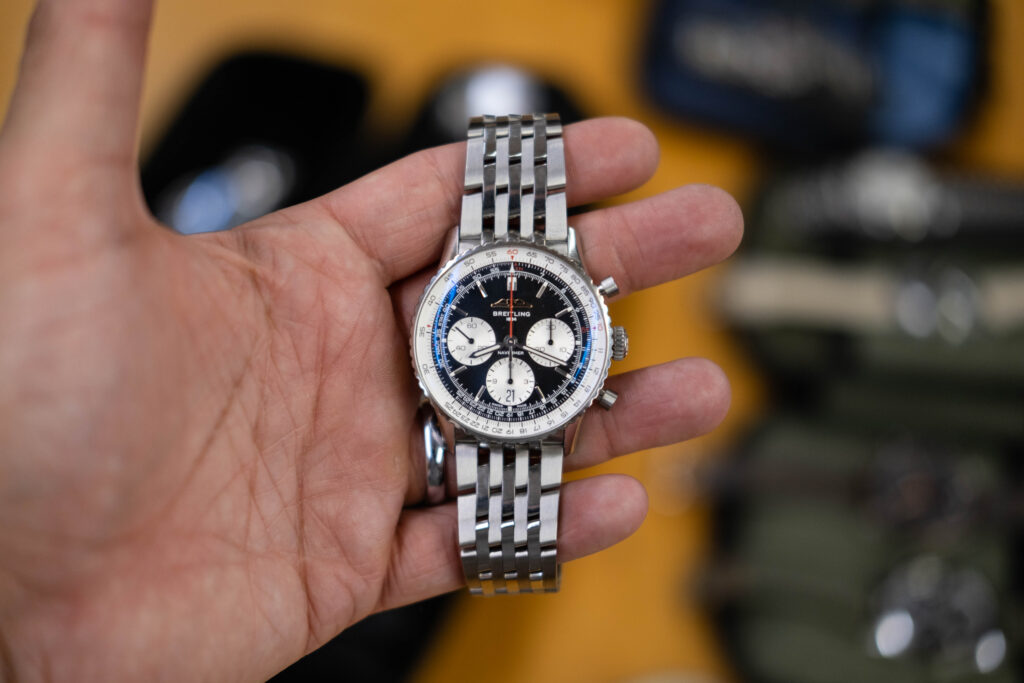
Consolidation in the watch industry has been predicted for a while. This time it showed up: Breitling is adding Universal Genève and Gallet to the family. It is not the subject of the week, but it is one of the big ones, and it caught my attention for a reason that has little to do with watches.
I saw other examples of consolidation in other industries this week, and they were being filed under “bad”. So I started wondering about the watch side. Is this a good thing or a bad thing for everybody else?
What Breitling is doing
I am not going to break down how Breitling is positioning this. A lot of people already did, and the best analysis I found is from Velociphile on Substack. Why would I give you a half-baked summary when the details are already out there, and well done? Go read it.
The short version: the segments make sense.
- Universal Genève is the super luxury tier.
- Breitling is luxury.
- Gallet is the entry luxury tier.
Breitling recently went up in price. That tells me they were leaving a piece of the pie empty, and Gallet can fill it. With Universal Genève on top, the group now covers three layers of luxury. That makes it a much more serious competitor against Richemont, Swatch Group, and LVMH.
Five Forces, watch edition
To answer the good or bad question, I ran it through Porter’s Five Forces.
New entrants. A new brand can make a great watch. What it cannot do is manufacture a hundred plus years of heritage, and a lot of what customers are buying is exactly that. Gallet is regarded as the oldest watch and clock brand out there. Good luck copying that.
Supplier power. This is the clearest benefit of consolidation. A large group has more leverage than a single brand: shared sourcing, manufacturing capacity, movements, cases, distribution, logistics, you name it. Remember last episode, when we compared Fears with Frédérique Constant? Same idea. It is not about manufacturing prices, it is about what a bigger group can put behind every brand in it.
Buyer power. This one goes either way. More brands on the shelf, but one parent company behind them. If your reputation as a customer gets damaged, or you get blacklisted by one brand, you could be blacklisted by the whole group. That is not good. The choice looks wider than it is.
Substitutes. Here the consolidation helps Breitling defend itself and have a bigger presence next to the big groups. The other substitutes question, younger generations spending on travel and experiences instead of something tangible, is a topic for another time. Consolidation does not change it.
Rivalry. Group against group gets more interesting, since Breitling now has more weight to throw around. But I do not see the competition thinning out, and that is where the movies come in.
The Hollywood comparison
In the movie industry, actors and directors are very much against studios being bought. When a studio is bought, the studio goes away. You do not get two studios under one roof, you get one bigger studio. Less competition, fewer options to get your movie developed, fewer places to find a job.
Quick disclaimer: what I know about the film business is superficial. I am not analyzing it, just using it as a comparison. But it is a good one, because the suppliers flip. In watches, suppliers are the movement makers and component makers: jewels, dials, retailers. In film, they are the actors, directors, writers, and special effects houses. If ten studios become five, those suppliers lose bargaining power. In watches, the group gains it.
| Force | Watches (Breitling group) | Movies |
| New entrants | Heritage is hard to copy, which protects established brands | Studios gain more control of IP, but YouTube and small platforms let people start small. Someone always rocks the boat |
| Supplier power | The group gains leverage through shared sourcing, manufacturing, and logistics | Actors, directors, and writers lose bargaining power |
| Buyer power | Could go either way, with a group-wide blacklisting risk | Lower. Fewer studios means you take the IP on offer or you watch nothing |
| Substitutes | Not changed by consolidation | YouTube is still big, and other media still compete for attention |
| Rivalry | Group versus group gets tougher, but the field is not thinning | Still high, but lower than before, since there are fewer studios |
A note on the substitutes row. For watches, I was comparing groups. For movies, I was comparing platforms and mediums fighting for attention. Not the same thing, so read that row with care.
How other groups did it
The Hollywood comparison only goes so far. The watch industry has its own track record, and most of it looks fine.
Swatch Group. It started as a consolidation of SSIH and ASUAG during the quartz crisis, bringing together Omega, Tissot, Longines, Rado, Certina, Hamilton and others. Then came Blancpain and Frédéric Piguet in 1992, Breguet in 1999, and Glashütte Original in 2000. I do not think they killed any of the brands, and they segmented well. Omega does not feel like Longines. Breguet does not feel like Blancpain. Blancpain definitely does not feel like Swatch. Frédéric Piguet was absorbed by Blancpain as its manufacturer, so supplier power inside the group is huge, and so is distribution. I have only touched on Swatch Group in passing on the show. One for the future.
Richemont. It bought [CONFIRM: manufacture named in the audio] and the remaining stake in JLC, which gave it control of Jaeger-LeCoultre. It also has IWC and A. Lange & Söhne, plus Cartier, Vacheron, Piaget, Panerai, and Baume & Mercier. Manufacturing and distribution live inside the group, so it is as strong as Swatch Group. The brands stay very distinct. There might be some overlap here and there, but so far so good. I have nothing to add.
Citizen and Frédérique Constant. We touched on this one last week. Citizen also owns Alpina and brings huge distribution in Japan and the U.S., plus manufacturing. Frédérique Constant already had its own manufacturing, so it does not depend on Citizen. This might be a case where consolidation helped the smaller watchmaker: distribution, investment, R&D, purchasing power, geographic reach. Another good example.
Kering, in reverse. This is the interesting one. It was a group being dismantled, not formed. In 2022, Kering sold Girard-Perregaux and Ulysse Nardin to their own management. Basically: we do not care about watches anymore, get rid of them. Belonging to a giant luxury conglomerate is supposed to be a competitive advantage, like the first three examples show. So why leave? I do not know if I would call it unsuccessful, but it proves that separation happens too, not just consolidation.
Movado, Ebel and MVMT. Far from high horology here. These are mall brands, and MVMT was a young, digital, mostly online brand with a young audience. Consolidation happens at this end of the market too.
Where it goes wrong
So, good or bad? It depends. A lot of it depends on who is buying.
The latest aBlogtoWatch podcast, on why watch brands need people, passion, and autonomy, with Ahmad Shahriar, makes a point worth hearing. When an old Swiss brand absorbs another one, it often fails to follow what made that brand successful. A common move is to send an expat manager from Switzerland to run a specific country. From what they discussed, the results of that have not been great.
The other issue is power distance. In a country like Japan, power distance is high, meaning authority speaks and things happen. You do not challenge it. The whole organization is hierarchical. In the U.S. it is lower. Flatter organizations, and easier communication between managers and employees. According to that episode, the Swiss have not learned to handle this properly.
So if a Swiss brand comes in, absorbs another, and does not know what to do with it, it can borderline kill it. Almost what happened with Zodiac. Fossil absorbed it, and when Fossil Group ran into financial trouble, Zodiac almost did not make it. It is still alive. But the parent’s problems became the brand’s problems.
My take
In Breitling’s case, two brands are being resurrected to compete in two different segments. I think that could be good for customers. The one downside I see is the one from earlier: a bad relationship with the group can follow you across all three brands. Same goes for people who work there. Quit or get blackballed by one brand, and you might be blackballed by all of them.
What I do not see is the thinning of competition that is happening with movie studios. There is consolidation among the big brands, and it is worth watching. This one looks more like a group building out a portfolio than a market shrinking.
If you want to get more into the weeds of the watch industry, I recommend the aBlogtoWatch episode. The guys at Collective have also commented on this before.
And if you have questions or comments, let’s keep this conversation going. I am most active on Instagram, where I try to spark something about the car, watch, and photography industries. Leave a review or share the episode if you liked it. We have a huge catalog now.
Thank you for stopping by,
DL
Discover more from 3DLANES
Subscribe to get the latest posts sent to your email.