This post is a companion to the latest 3DLANES podcast episode.
Cosworth started in London in October 1958 by Mike Costin and Keith Duckworth, both former Lotus men, the company name is literally just their surnames stapled together. COStin. DuckWORTH. Cosworth. Duckworth apparently did not enjoy working at Lotus very much. He left after two months. His wife Ursula helped him run the fledgling operation while Costin finished out his contract with Colin Chapman and couldn’t join full-time until 1962. Cosworth went on to become one of the most successful independent engine manufacturers in the history of motorsport.
The DFV: The Engine That Opened Formula 1
In 1966, Colin Chapman, the same man Duckworth had walked away from, convinced Ford to fund a new 3.0-litre Formula One engine. Ford wrote Cosworth a £100,000 check. The goal was straightforward: build a four-cylinder Formula 2 engine first as proof of concept, then deliver a V8 for Formula 1.
What Cosworth delivered was the DFV. Double Four Valve. A compact 90-degree V8 that was also designed to be a structural member of the chassis itself, a concept Chapman championed and Duckworth executed. The DFV won on its debut at the 1967 Dutch Grand Prix, Jim Clark driving. From 1968 onwards, Ford and Cosworth made the engine available for purchase by any team. That decision changed Formula 1 permanently. McLaren, Tyrrell, Williams, the “garagiste” era of independent constructors, all of it was enabled by a customer engine program that nobody had seen before at that level.
The final tally: 155 World Championship race wins, 12 Drivers’ Championships, 10 Constructors’ titles. Cosworth sits third all-time in total F1 wins at 176, behind Ferrari and Mercedes. Not a bad return on £100,000.
The DFV’s American cousin, the turbocharged DFX variant, showed up in IndyCar in 1975 and won ten consecutive Indy 500 events. Ten. Consecutive.
The Road Car Years and the Ford Connection
Cosworth’s relationship with Ford extended well beyond the track. The Sierra RS Cosworth arrived in 1986 a 2.0-litre turbocharged, 204 PS, whale tail spoiler, built in a minimum production run of 5,000 for homologation. The RS500 followed in 1987 and proceeded to dominate Group A touring car racing across multiple championships through 1992, including the 1988 Bathurst 1000 and the 1988 DTM. In 1994, the Zetec-R V8 Cosworth produced for Benetton powered Michael Schumacher to his first Formula 1 World Championship. The last Ford-powered F1 title. Still.
These were not quiet years for the company’s ownership structure either. Keith Duckworth sold his stake in 1980. United Engineering Industries, then Carlton Communications, then Vickers, then Audi all held the keys at various points. In 1998, Audi bought the company and promptly split it in two, retaining the engineering and manufacturing side while selling Cosworth Racing and Pi Research to Ford. Ford later sold Cosworth Racing to Champ Car owners Gerald Forsythe and Kevin Kalkhoven in 2004. Audi sold what it kept to Mahle, which renamed it MAHLE Powertrain in 2005.
By that point, the brand had been sliced and reunified enough times to confuse anyone. But somehow, the identity held.
The Hypercar Pivot
Cosworth’s last premier-class F1 engines went to the Marussia team in 2013. After that, the company pivoted. The move was not toward retirement, it was toward the top of the market.
The current program roster reads like a who’s who of the hypercar segment:
| Program | Client | Engine | Key Specification |
| Valkyrie | Aston Martin | RA V12 | 6.5L NA, 1,000 hp, 11,100 rpm |
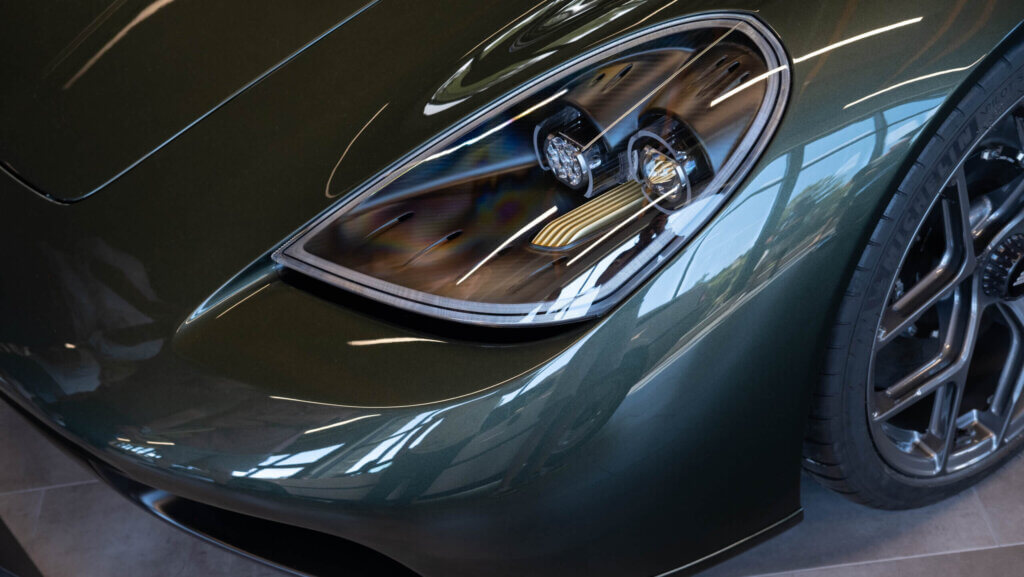
| T.50 / T.33 | Gordon Murray Automotive | GMA V12 | 4.0L NA, 654 hp, 11,500 rpm |
| Tourbillon | Bugatti | V16 hybrid | 8.3L NA, 1,000 PS ICE (1,775 hp total) |
| RB17 | Red Bull Advanced Technologies | V10 hybrid | 4.5L NA, 1,000 hp, 15,000 rpm (50 units) |
| Bizzarrini | Bizzarrini (revived brand) | TBD | Partnership announced 2024 |
Gordon Murray reportedly specified the T.50’s engine displacement at exactly 4.0 litres to match the Lamborghini Miura’s original unit, just for the connection it implies. Cosworth had to engineer to that predetermined brief with little flexibility. That is what it means to be a supplier to clients who operate with strong points of view. The Red Bull RB17 engine, built to a 15,000 rpm ceiling with electric hybrid assist, is limited to 50 units. The IP belongs to Red Bull, not Cosworth. They built a masterpiece and handed over the title deed.
The Business Reality
Cosworth is not competing with Porsche or Ferrari on volume. Its real competition is a narrow group of specialist engineering houses: Ricardo, AVL, Multimatic. And the threat is not necessarily that those firms win the business, but that future ultra-luxury clients go fully electric and remove the addressable market entirely. Management has publicly stated their belief that internal combustion has a long future in the luxury sector. Every current hypercar client has backed that view with a purchase order.
The ingredient branding strategy, Cosworth cam covers visible on the Valkyrie, the T.50, the Tourbillon, this is the promotional backbone. 176 Formula 1 wins does a lot of work in a sales conversation with the kind of client who specifies displacement by referencing a 1966 Lamborghini.
Thank you for stopping by,
DL
Discover more from 3DLANES
Subscribe to get the latest posts sent to your email.