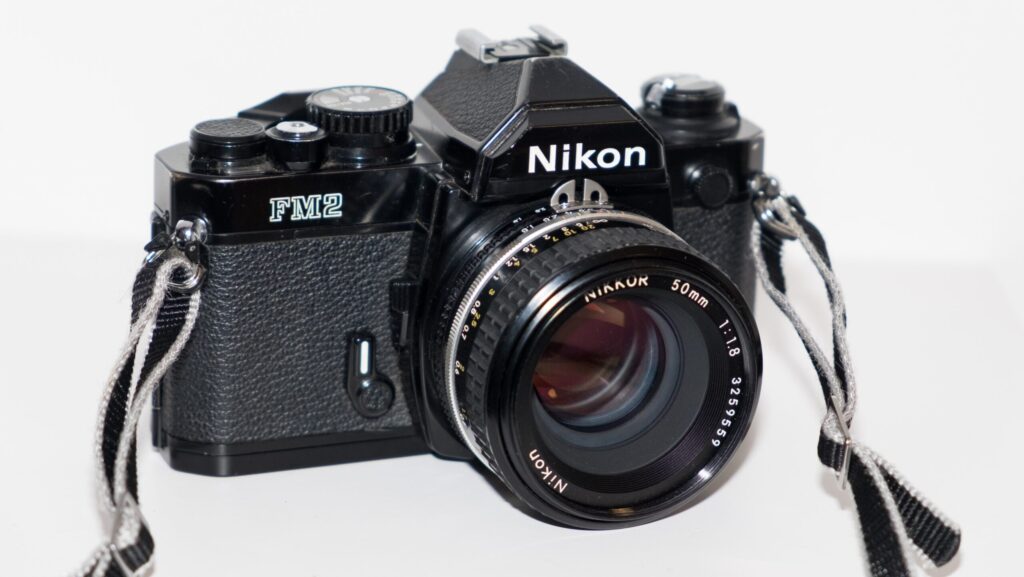
This post accompanies the latest 3DLANES podcast episode discussing the Nikon FM2, its origins, its place in photography history, and the competitive landscape at the time of its introduction.
The Nikon FM2 was positioned between enthusiast and professional-grade equipment, a flagship-level camera at a mid-tier price. It remained in production for 19 years (1982–2001), becoming Nikon’s longest-produced SLR. This longevity reflected Nikon’s ability to respond to customer feedback while maintaining a consistent value proposition.
The original FM2 (1982–1983) featured groundbreaking titanium (Ti) honeycomb shutters, enabling a 1/4000th shutter speed with flash synchronization at 1/200th of a second.
The FM2n (New FM2) introduced 1/250th flash synchronization and, after 1989, transitioned from titanium to aluminum shutters.
The limited-production FM2/T (1994) utilized titanium top and bottom plates, reducing weight by 32 grams, while retaining aluminum shutters.
Technological Innovation
The 1/4000th shutter speed was one of the defining features of the FM2, effectively doubling the 1/2000th industry standard at the time. This was achieved through the use of vertical shutter curtains rather than traditional horizontal designs, complemented by a distinctive honeycomb-patterned titanium construction.
The film transport mechanism was engineered for durability and minimal maintenance, using high-strength hardened metal gears and ball-bearing-mounted components designed for self-lubrication.
The camera remained fully mechanical, requiring a battery only for the TTL light meter.
Strategic Positioning
By 1982, approximately 80% of Japanese households owned at least one 35mm camera, signaling a saturated market. Advances in lightweight materials and computer-aided lens manufacturing commoditized production, compressing margins across the industry. At the same time, consumers increasingly favored point-and-shoot cameras, reducing SLR market share to roughly 15%.
Nikon operated with a dual strategy:
- Maintain mechanical excellence, prioritizing reliability over electronics
- Position the FM2 as a secondary or backup body, primarily targeting professional photographers
Canon’s introduction of the EOS system, with autofocus and electronic lenses, began eroding Nikon’s dominance among professionals. The FM2 also competed with the AE-1, which emphasized electronic advancements and targeted amateur photographers, prioritizing market share over premium positioning.
Pentax competed with the MX and LX. The MX aligned more closely with the original FM, while the LX offered professional features at a price point closer to Nikon’s flagship F3 rather than the FM2.
Olympus, with the OM-1 and OM-2, focused on compact form factors, initiating the compact SLR movement in the early 1970s and targeting amateur users over professionals.
4P Analysis
Product
The 1/4000th shutter speed and 1/250th flash synchronization represented best-in-class specifications at the time.
Durability and build quality justified the FM2’s premium positioning. Combined with Nikon’s extensive lens ecosystem, switching costs were reduced, allowing photographers to use the FM2 as a backup body without changing lenses. This reinforced system-level lock-in within the Nikon ecosystem.
Price
Nikon employed value-based pricing, setting FM2 prices based on perceived professional-grade value rather than cost-plus calculations.
Premium Tier Positioning:
Launch pricing at $364 (1982) positioned the FM2 approximately 20–30% above mass-market alternatives (Canon AE-1 ~$300–350) but 30–50% below flagship models (Nikon F3 ~$600–800, Pentax LX ~$600–800). This intermediate positioning captured users seeking professional performance without flagship-level investment.
Price Escalation Strategy:
Prices increased to $525 (1988) and $745 (1995), generally tracking inflation while reinforcing premium positioning as the product matured. Maintaining pricing despite aging technology signaled confidence in its long-term value proposition and leveraged brand loyalty.
Discount Structure:
Typical retail discounts of 30–40% from list price allowed flexibility for dealers while preserving a premium perception through higher list pricing.
Competitive Price Anchoring:
Positioning between mass-market and flagship tiers leveraged anchoring effects, offering perceived value relative to higher-end models while maintaining differentiation from lower-cost alternatives.
Current secondary market pricing ($250–500 for FM2/FM2n; $700–850 for FM3a) reflects continued demand driven by both film photography resurgence and collector interest.
Place
Distribution relied on authorized dealer networks, varying by market and geography. The FM2 was not as widely distributed as Canon models and was more commonly found in specialized camera stores rather than general retail outlets.
This selective distribution created a degree of scarcity and reinforced its positioning within professional-oriented channels. Strong service infrastructure in key markets further supported professional users and justified its premium positioning through ownership experience.
Promotion
The FM2 was promoted as a professional backup camera, reliable, durable, and capable of providing redundancy. It also served as an aspirational product for enthusiasts.
Marketing relied primarily on print media rather than mass-market television advertising, unlike Canon’s approach with the AE-1. This resulted in a more targeted marketing strategy focused on the intended user base.
Listen to the full discussion on the latest 3DLANES podcast episode.
Thank you for stopping by,
DL
Discover more from 3DLANES
Subscribe to get the latest posts sent to your email.