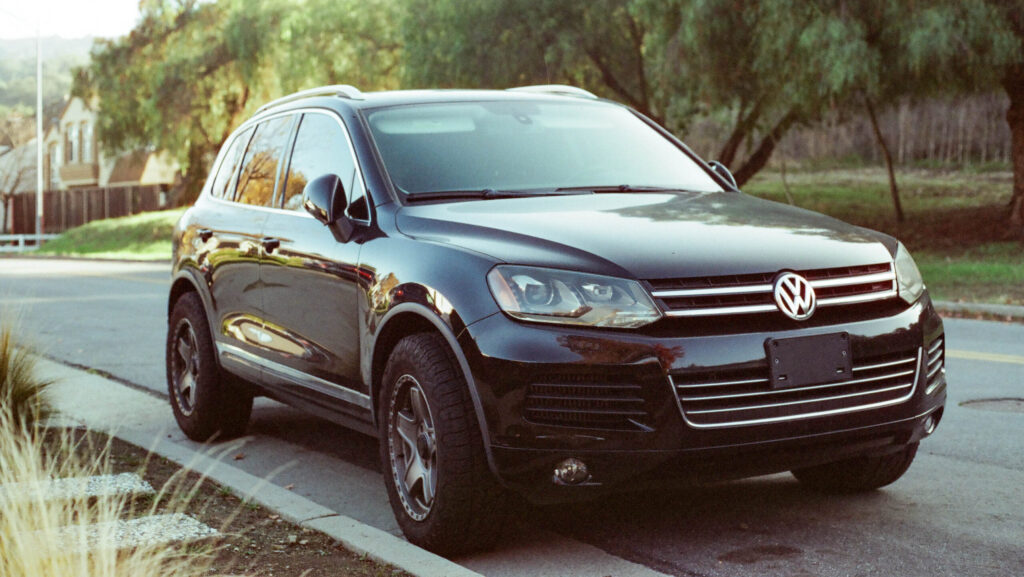
Brief Origin Story
The Touareg was Volkswagen’s first SUV and was developed as part of a joint program with Porsche and Audi under what became the PL71 platform.
At the time, Porsche was facing financial pressure and evaluating new product directions. Rather than pursuing a van, the company chose to enter the SUV segment, aligning with a growing market shift. This decision resulted in a shared development effort that produced the Touareg, Cayenne, and later the Q7.
Volkswagen’s objective was clear: build an off-road capable vehicle that could also deliver strong on-road performance. The engineering approach combined unibody construction with durability characteristics typically associated with body-on-frame vehicles.
The Touareg later transitioned to the MLB Evo platform in its third generation, shared with the Audi Q8, Bentley Bentayga, and Lamborghini Urus.
The name originates from the Tuareg people of the Sahara Desert, referencing endurance and the ability to navigate harsh environments.
Launched alongside the Phaeton, the Touareg formed part of Volkswagen’s move into the luxury segment, serving as a platform for introducing technologies such as air suspension, advanced driver assistance systems, and hybrid powertrains.
Three Generations at a Glance
The Touareg evolved across three generations, maintaining its position in the mid-size luxury SUV segment while adopting new platforms and technologies.
| Attribute | Gen 1 (7L) | Gen 2 (7P) | Gen 3 (CR) |
|---|---|---|---|
| Years | 2002–2010 | 2010–2018 | 2018–2026 |
| Units Sold | ~471,000 | ~483,000 | ~265,000+ (2025) |
| Key Engine | 5.0L V10 TDI | 3.0 V6 Hybrid | 3.0 V6 eHybrid R |
| Standout Feature | W12 option, off-road focus | Hybrid introduction | Innovision Cockpit |
| Platform | PL71 | PL71 (evolved) | MLB Evo |
| US Availability | 2004–2010 | 2011–2017 | Not sold |
4P Analysis
Product
The Touareg was positioned as a mid-size luxury crossover SUV, competing with vehicles such as the BMW X5 and Mercedes-Benz GLE, while also overlapping internally with the Porsche Cayenne and Audi Q7.
It combined off-road capability with a wide range of engine options, including VR6, V8, W12, and V10 TDI configurations. The model also introduced technologies that later appeared across the broader Volkswagen lineup, including air suspension systems and early driver assistance features.
The Touareg also established a presence in motorsport, with multiple Dakar Rally wins between 2009 and 2011.
Price
Pricing varied by generation and market but remained within the luxury segment, typically positioned below comparable offerings from BMW and Mercedes-Benz.
| Market / Year | Price Range |
|---|---|
| US, 2005 | ~$37,000 – $67,000 |
| US, 2011 | $44,450 – $57,500 |
| US, 2017 | $49,495 – $60,195 |
| Europe, 2022 | ~€60,000 – €85,000 |
| Europe, 2026 | From €75,025 |
| China, 2024 | ~$83,000 – $118,000 |
Place
All three generations of the Touareg were produced in Volkswagen’s Slovakia facility and distributed globally across up to 39 markets.
Key markets included Germany, the United States, China, Australia, the Middle East, South Africa, and Russia. Distribution relied primarily on Volkswagen’s existing dealership network, with the Touareg positioned within standard showroom environments.
Promotion
Promotion varied by region but consistently emphasized capability and performance.
Examples include the towing of a Boeing 747, appearances in films such as The Bourne Ultimatum, participation in the Dakar Rally, and regional campaigns such as museum shuttle use in China and a cabrio-themed advertisement in Spain.
Production and Design Challenges
The Touareg experienced several recurring engineering and operational challenges across its lifecycle.
Mechanical issues included air suspension failures, timing chain tensioner problems (notably in 2010–2012 models), and coolant leaks in V6 TDI engines. The 2010 transition year between generations also introduced inconsistencies due to mixed components and software integration issues.
Regulatory challenges affected diesel variants, particularly the V10 TDI, which was withdrawn from the US market due to emissions compliance requirements. The broader Dieselgate issue in 2015 also impacted Touareg variants.
US Discontinuation
The Touareg was discontinued in the United States after the 2017 model year.
This decision followed declining sales and the introduction of alternative models within Volkswagen’s portfolio, including the Atlas (Teramont globally) and an expanded Tiguan offering. Diesel-related challenges and pricing sensitivity within the US market also contributed to the decision.
Global Discontinuation Context
Global production volumes declined from approximately 80,000 units in 2011 to around 31,254 units in 2022.
Volkswagen shifted focus toward higher-volume SUV models, while luxury positioning within the group was increasingly concentrated under Audi and Porsche.
Engines By Generation
| Generation | Engines Offered | Breakdown |
|---|---|---|
| Gen 1 (7L) | 12 | 5 petrol · 7 diesel |
| Gen 2 (7P) | 10 | 4 petrol · 1 hybrid · 5 diesel |
| Gen 3 (CR) | 7 | 2 petrol · 2 hybrid · 3 diesel |
I hope this post gives you a good background of the Volkswagen Touareg. Remember to listen to the podcast for more details.
Thank you for stopping by,
DL
Discover more from 3DLANES
Subscribe to get the latest posts sent to your email.